

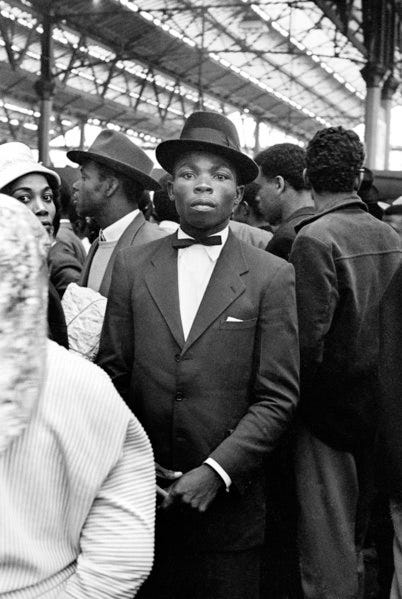
It’s hard to imagine now, but 75 years ago with the arrival of the Empire Windrush at the Port of Tilbury in Essex, there was a two-decade long wave of immigration from the Caribbean that would have a profound impact on our nation. It would change the way we look and feel forever. It would enrich our culture, and people the public services that are still with us today, though perhaps now looking every bit their age.
It is striking, looking back, that despite the well documented tensions, there was also a post-War optimism that accompanied this migration to, and integration into, the ‘mother’ nation. While there is little to celebrate in Empire there is something to be said for the sense of commonality it’s memory engendered - the commonwealth of nations was to be writ small on this island.
But I worry this is not the story we tell ourselves. As I have previously discussed, there is a profound discomfort with ‘the national’ today. And yet, despite the long years of prejudice and the political struggle for equality, there used to be a very real sense of national belonging. Those who had just set foot in the UK for the very first time felt that they were - indeed they were told they were - British.
A sentiment Brexiteers would do well to make much more of. This sense of a shared history beyond the continent of Europe. Mass migration then meant something very different to what it means today. It was part of a plan to rebuild the nation after the war, and we would be learning the wrong lessons if we were to imagine we could import our way out of our labour shortages today.
But still, this story we have in common, this continuity with a shared past as well as a post-Windrush era of great change and social progress, is a challenge to the new racialists - the BLMers and unconscious bias entrepreneurs who like to weaponise our immutable differences. It shows that things do change, communities change, nation’s change, mind’s change. But we are still one people for the most part getting along.
The mass migration of those decades after the war created the famed cultural melting pot that made us what we are. The point being that we fused as a nation, our differences being merely interesting not defining. Contrast today’s skin-deep and divisive corporate identitarianism.
The government’s Windrush 75 campaign organised National Windrush Day to celebrate ‘a seminal moment in our shared history’ and the arrival of these migrant ‘pioneers’. A week of events were held across the country from the Tilbury Docklands and Sheffield Caribbean Sports Club, to a procession from Clapham Common to Brixton’s Windrush Square.
The Department for Levelling Up, Housing and Communities organised a series of talks with charity Speakers for Schools and launched a new educational resource on the National Windrush Monument website. There was a ceremony for Windrush veterans on Armed Forces Day in Birmingham. There were displays and talks at Victoria and Albert Museum, a National Archives web portal, and ‘Windrush: Portraits of a Generation’ a project commissioned by King Charles III. The Royal Mail released commemorative stamps, and the Royal Mint minted a new commemorative coin.
Minister for Communities at DLUHC, Lee Rowley, spoke of how the idea was to ‘reflect upon and recognise those who have done so much to strengthen the life of our nation’. Quite right too. In fact, 75 years on feels like a good point to mark this milestone in the nation’s history, but also to disembark and look around at what became of that port.
I lived in Thurrock in the late 1990s, and would wander through the wasteland of the by then depressed white working class areas around the Tilbury Docks. The greatest hopes for those who lived there were invested in the arrival of a shopping mall. It is these ‘left behind’ areas, the once thriving docklands, the coastal communities, the mining villages, the deindustrialised midlands, that we should now be turning our attention to.