

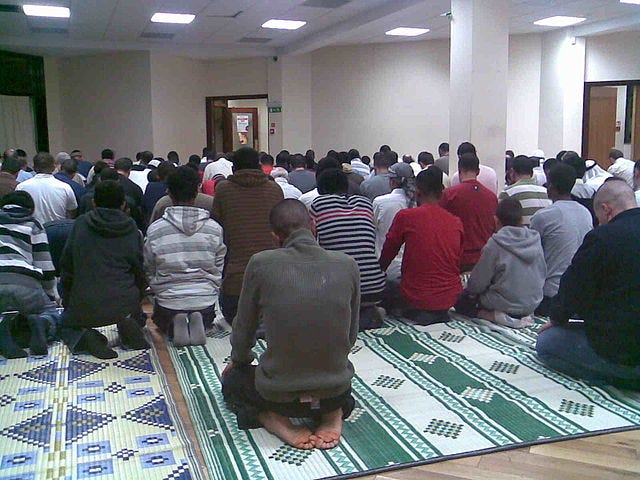
You might say we already are. And understandably so. But when we do talk about Islam, it’s because of the latest terrorist atrocity, grooming gang scandal or hate-fuelled ‘pro-Palestine’ march. Not that we shouldn’t do that - nobody, even Starmer’s supposed ‘far right thugs’, should be shut up by the threat of a prison sentence. Those who avoid all discussion of Islam and Muslims because they don’t want to be accused of being ‘Islamophobic’, are being cowardly and offending against something far worse. A shared national culture - or what was a shared national culture - of open, honest, debate. Still, those troubling, and increasingly so, incidents shouldn’t be the only reason to discuss the importance of the UK’s 4 million Muslims to our national life.
Actually that term - Islamophobic - is a good place to start. It can mean many things, and not just anti-Muslim prejudice. It can also mean offending against Islam itself, as a religion. As the recent exchange at Prime Minister’s Questions confirmed. I have a particular interest in this, because Birmingham Hall Green and Moseley MP Tahir Ali, who asked the question, represents a constituency I was born and raised in. And I remember well the casual racism of my early childhood. Neighbouring Sparkhill and Sparkbrook were predominantly Asian areas. Hall Green, where I lived, was predominantly white. You could hardly fail to notice the segregation of communities as you got on the No.6 from Hall Green, through Sparkhill along the Stratford Road to Birmingham’s old city centre.
That has changed, quite considerably, since I left. There is still that difference in populations, but Hall Green is much more mixed ethnically than it was then. But there has been a shift in emphasis in the way we talk about these areas. While white residents still refer to ‘Asians’, they also refer to areas like Leyton where I used to live in East London, as a Muslim area. That shift in emphasis from racial description to religious categorisation, I think, tells us something about a wider shift in the significance of this population at the level of values. The old racism is, no doubt, still there but I would argue much less widespread in the decades since I left Birmingham for London. In it’s place is something no less troubling in my view - a sense that we are living in communities separated quite rigidly by culture and belief.
And Mr Ali personifies that division. His question, timed to coincide with Islamophobia Awareness Month (another to add to the ‘awareness’ calendar I mentioned in my speech at the Battle of Ideas), was this:
Last year, the United Nations Human Rights Council adopted a resolution condemning the desecration of religious texts, including the Koran, despite opposition from the previous government. Acts of such mindless desecration only serve to fuel division and hatred within our society. Will the prime minister commit to introducing measures to prohibit the desecration of all religious texts and the prophets of the Abrahamic religions?
He followed up with a tweet explaining that he just wanted to ‘prevent acts that fuel hatred in society’. Perhaps he had in mind the autistic child hauled before the great and the good - imam and police included - for ‘scuffing’ a Koran? As the father of an autistic boy, I was rather more concerned about the medieval cross-examination that child was subject to than the easily offended sensitivities of local religious and law enforcement authorities. Either way, reasonable, liberal-minded folk - Mr Ali’s fellow MPs included, were outraged at what they saw as a call for the reintroduction of a blasphemy law.
This was welcome, even a little unexpected. I’ve come to expect the worst sentiments to be endorsed in these illiberal times. It was good to see too that the greatest uproar amongst those who are still prepared to defend our freedom, was not at what Mr Ali said so much as Prime Minister Starmer’s apparent endorsement,
I agree that desecration is awful and should be condemned across the House. We are, as I said before, committed to tackling all forms of hatred and division, including Islamophobia in all its forms.
It’s not as if there isn’t a lot of hate around. In London, anti-Semitic hate crimes have exceeded ‘Islamophobic’ hate crimes for the first time. While I have serious issues with the category of hate crimes, this trend is at least noteworthy when you consider that London’s Muslim population dwarfs that of its Jews. While more than half of British Jews live in London, that only amounts to 270,000 compared with approaching 1.5 million Muslims. Since last year’s October 7th Pogrom, the Metropolitan Police have recorded 2,170 such incidents against Jews compared with 1,568 committed against Muslims. This is quadruple the pre-Pogrom figure. So you can, I suppose, understand why those marches, and the comparative silence on the horrors of the event that triggered Israel’s response, are such an issue.
Not that it’s a competition. We shouldn’t be even entertaining talk of outlawing hatred of anybody or anything. Hate is an emotion. We all have them. The police should concern themselves with crimes, not people’s affective states - no matter how deranged or hateful they may be. It is, as they say, a waste of police time. But we should be very concerned about the sectarian trend in our politics. It’s not just Mr Ali pointing in that direction. It’s the Gaza Five too, a gang of independent MPs who won their seats at the General Election in traditionally Labour-voting constituencies. But the threat they pose to our political culture is much wider. As Kemi Badenoch put it, she fears Farage and chums less than ‘the five new MPs elected on the back of sectarian Islamist politics, alien ideas that have no place here’.
It’s been a long time coming. For Ayaan Hirsi Ali, ‘the arrival of fundamentalist Islam in the West, the rise of far-left critical theories of social justice and the advent of the internet as the public square’ are behind much of what we are seeing today. The first of these is echoed in an interview with an illegal migrant to the UK who found herself both cowering from rioters in her hotel, while oddly sympathetic. As she says,
We fled radical, violent Islam in our country and do not wish to see similar behaviours here in the free world.
I think there is another, perhaps critical, factor. Our own culture is dying and those who might once have defended it have rather given up on doing anything about it. They don’t, as I wrote in my last piece for Substack, identify with the ideals or values of their own society anymore. Which is odd when you consider that somebody risking their life on a dinghy to get here, only to be put in danger by hostile natives, does identify with our values. Or is it? That very journey implies a commitment to freedom so many on our dry land have long forgotten if they ever knew. But these sentiments live alongside some that are indeed, as Badenoch says, alien.
Toby Young reminds us that Sir William Shawcross’ review of the Prevent programme, just last year, was critical of the mismatch between the three quarter Islamist threat that MI5 concerns itself with compared with the 11% of referrals to Prevent. He suggests the blob are much more minded to refer what I think Starmer might regard to be the ‘far right thugs’ in the making getting off on a very different kind of content. As Tom Slater explains,
Since 2005, 95 people have been murdered in Britain in Islamist attacks, while the far right has slain three.
Home Secretary Yvette Cooper, as a consequence of her own ‘rapid’ review, would like to water things down further with the expansion of Prevent’s remit to something called ‘extreme misogyny’. This seems unlikely to help with catching any budding young terrorists either. Still, amid all the tension and worry about a society struggling with the more extreme manifestations of Islam - but apparently unwilling to do much about it - there is cause for optimism too.
The British Muslim Patriot and chairman of Reform UK Zia Yusuf comes to mind as an example of an impressive figure whose allegiance to his country defies the usual stereotypes. As Rakib Ehsan explained some time before the historic vote, Muslim citizens in the US election - like their black and Hispanic fellow citizens - are increasingly lending their support to Trump, the supposed Nazi/Fascist/racist and Islamophobe. They rather like his hands off the Middle East (and the rest of the world) record, and tend toward a more conservative family values outlook that has little time for the increasingly woke Democrats. Muslim Americans are also, argues Ehsan, drawn to the inherently integrating American dream of material prosperity.
There are troubling times ahead for those of us who value this country, and what we believe to be its most precious values. But there are also many of us, Muslim Brits included, who are willing to stand up for those values. As those with more separatist and more sinister notions begin to feel emboldened by our hollowed out elite, we need to make ourselves heard.
Image by Mohsin