

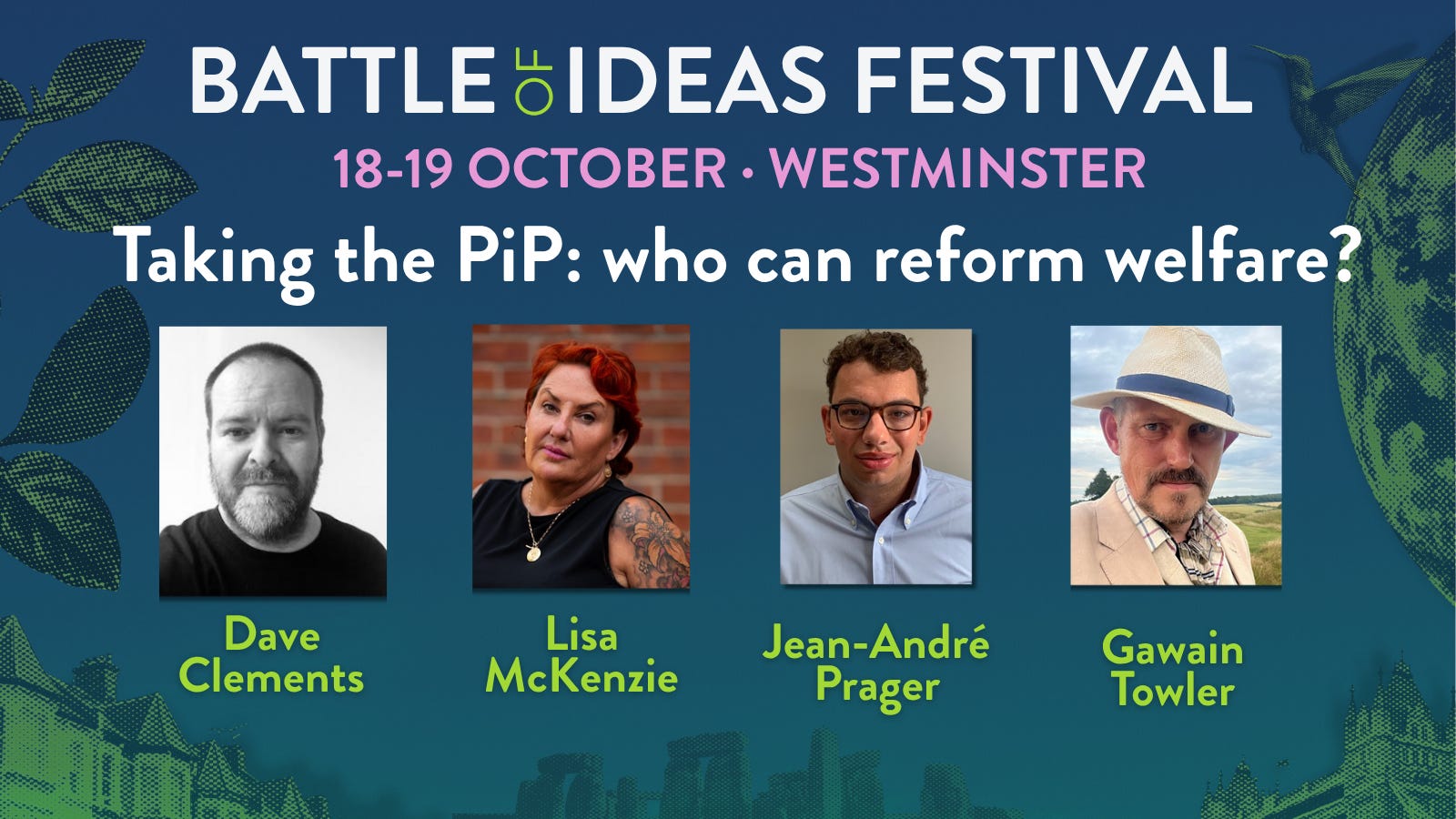
I’m delighted to have been invited to speak at the Battle of Ideas Festival next month, which is being held at Church House, Westminster. I’ll be speaking on a panel alongside Lisa McKenzie, working-class academic and author of Lockdown Diaries of the Working Class; Jean-André Prager, senior fellow at Policy Exchange; and [just added] Gawain Towler, former head of press at Reform UK.
The blurb for the session reads:
The government suffered serious embarrassment earlier this year when its attempts to rein in Personal Independence Payments (PIP) had to be hurriedly scaled back in the face of a backbench revolt. But the scale of welfare payments today remains a huge worry – and there seems little appetite to bring this spending under control. Earlier this year, there was a furore about the scale and availability of cars through the Motability scheme, which runs a fleet of cars said to be worth £14 billion.
According to the Department of Work and Pensions (DWP): ‘In 2025 to 2026 the government is forecast to spend £316.1 billion on the social security system in Great Britain. Total GB welfare spending is forecast to be 10.6% of GDP and 23.5% of the total amount the government spends in 2025 to 2026.’ Of this spending, £174.9 billion goes to pensioners and £141.2 billion to children and working age adults. Going forward, an ageing population means these costs will continue to rise – and that’s without the huge liabilities for public-sector pensions.
Moreover, does the emphasis on state-funded welfare make sense? With millions on working-age benefits for sickness and disability, many worry that too many people are being incentivised to remain out of work. A new report by Policy Exchange, Out of Control, identifies how poor incentives and ‘concept creep’ have stretched societal definitions of mental ill-health and neurodivergence so far that public services are stretched to breaking point, with costs of support spiraling to tens of billions each year.Getting people into work would make them better off, reduce the welfare bill and potentially improve the economic outlook, too.
What is to be done? Are politicians prepared to have the difficult conversations, from reducing working-age entitlements to increasing the retirement age? Is the debate unnecessarily gloomy about the UK’s ability to afford welfare in the future? Or will we face an abrupt financial reckoning if nothing is done?
For more details click here. I hope to see you there!