

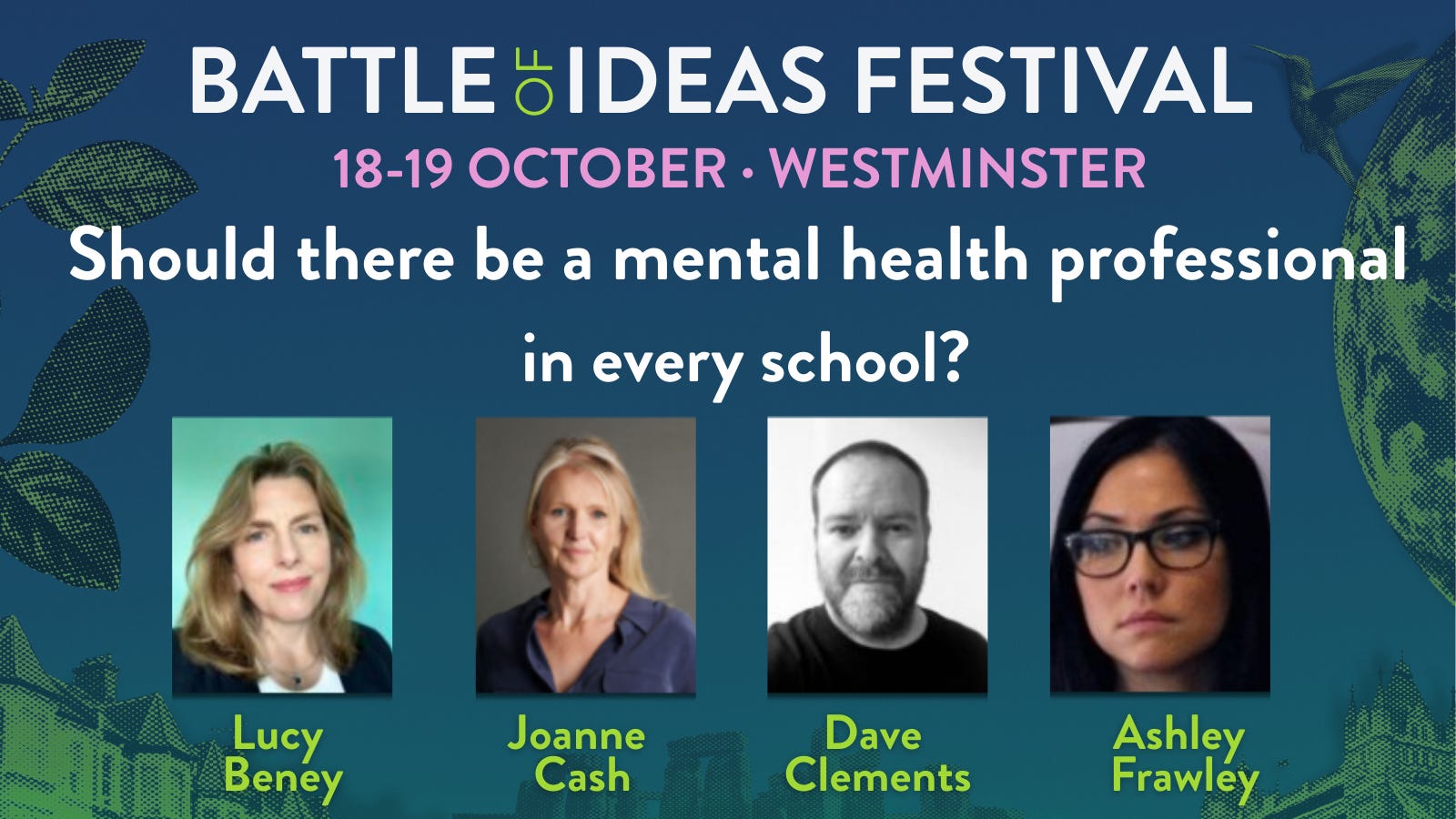
I’m delighted to have been invited to speak at the Battle of Ideas Festival next month, which is being held at Church House, Westminster. I’ll be speaking on a panel alongside Lucy Beney, counsellor and children’s correspondent at Save Mental Health; Baroness Joanne Cash, life peer and radical; and Dr Ashley Frawley, sociologist and author of Significant Emotions and Semiotics of Happiness.
The blurb for the session reads:
There is no doubt that far too many of our children and young people are not thriving mentally or emotionally in the way that they should be. In 2024, almost 20 per cent of school-aged children in the UK had been diagnosed with a mental-health condition, up from 10 per cent 20 years ago.
Meanwhile, the line between ‘learning disabilities’ and ‘mental-health issues’ has also become increasingly blurred. According to the charity ADHD UK, a diagnosis of ADHD is listed as a ‘mental-health disability’ under the Mental Health Act 1990. Over 1.6million pupils in England have been identified as having special educational needs and disabilities (SEND), up 24.9 per cent since 2016, while the number of children with an education, health and care plan (EHCP) has risen by an astonishing 83.4 per cent – up 11.6 per cent in the past year alone.
The care minister, Stephen Kinnock, has confirmed that the government is committed to its manifesto pledge to put a ‘mental-health practitioner’ into ‘every school in the country’. The idea has widespread support, with the Liberal Democrats and Conservatives offering similar commitments. Already, there have never been so many staff and volunteers working within schools with a specific responsibility for the emotional wellbeing of pupils: senior mental-health leads, educational psychologists, mental-health support teams and more. Access to counselling is available in many schools. Despite this booming school-based ‘mental-health industrial complex’, the wellbeing of pupils continues to deteriorate and rates of ‘mental illness’ continue to rise.
However, a recent Family Education Trust report by Lucy Beney, a qualified counsellor, asks if such interventions are not only ineffective, but perhaps harmful. She discusses everything from ‘diagnostic inflation’ and ‘social contagion’ to definitions of ‘mental health’ and ‘neurodiversity’, from the impact of schools encouraging young people to look at life through the subjective filter of their own feelings to the capture of mental-health professional bodies by critical social justice theory.
If one fifth of children are suffering so much that they are deemed as having a ‘disorder’, should our focus be on where we as parents and teachers are going wrong rather than what’s wrong with children? Is school the best place to address such mental distress, however it’s categorised? And what are the opportunity costs if classroom time and resources are taken away from academic pursuits that could potentially be more conducive to better mental health?
For more details click here. I hope to see you there!
Thank you, Dave – I'm looking forward to it!