

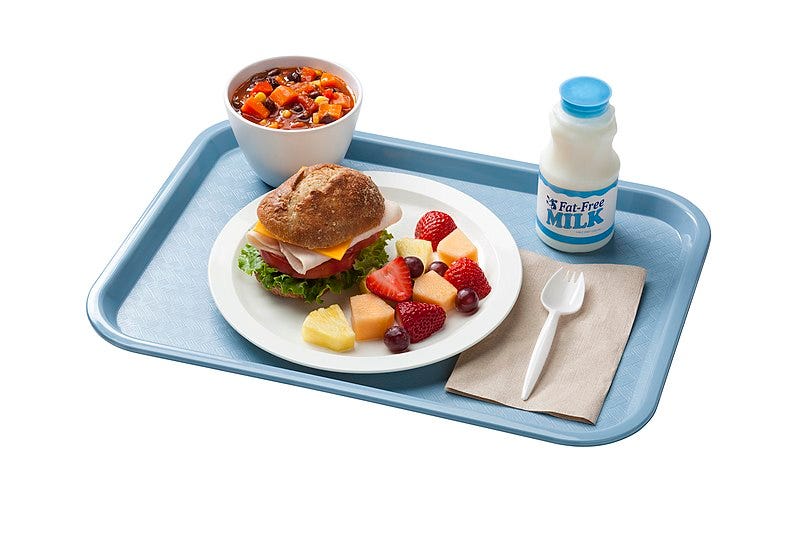
According to the government, nearly two million children - or a third of all pupils in England - are in receipt of free school meals. All children up to and including those in Year 2 get them, with only those whose families are in receipt of certain benefits and on the lowest incomes qualifying after this. They have become a marker of disadvantage, and largely the basis upon which schools in England receive their pupil premium funding to, hopefully, support and improve outcomes for ‘disadvantaged children’.
There was also recovery premium funding, additional one-off funding, for the 2021/22 academic year. An implicit admission of the damage done to these children by the policies of lockdown and school closures. Labour MP Zarah Sultana - who supported these policies - recently laid a Bill before parliament that would extend universal free school meals to all primary school children in England. The administrations in Scotland and Wales are already committed to it.
The usual celebrity suspects are lining up in support of it too. Everybody from school dinner Scrooge Jamie Oliver, and former One Direction member Zayn Malik, to practically canonised footballer Marcus Rashford - who campaigned for their extension into the school holidays - and Hollywood actress Kate Winslet , is concerned that a deep injustice is being done. That in one of the richest countries in the world our children are going hungry.
To which we are entitled to ask, really? While the narrative is a seductive one, it is important to understand what is going on before jumping on the bandwagon. There’s no getting away from the fact that the question of need is increasingly complex and confused these days. It may not be as bad as it was - there are no workhouses, or hungry children begging on the streets like there were in the 19th Century, or the grinding poverty that led to the establishment of the welfare state in the 20th. But there is, for a variety of not always straightforward reasons, a rise in special, mental health and behavioural needs, in addition to significant poverty.
It is indisputable that children are turning up to school showing signs of deprivation, that some families can’t make ends meet and struggle to afford the essentials. Education charity The Sutton Trust reports that children not receiving free school meals and yet unable to afford lunch, is a growing issue in over half (52%) of schools. Three-quarters (74%) describe an increase in children looking tired or unable to concentrate; two thirds (67%) are experiencing more behaviour problems, over half (54%) an increase in children without adequate clothing; and over a third (38%) say more are turning up to school hungry.
Still it is not unreasonable to suggest that the most disadvantaged families in the UK today, while facing a cost of living crisis - and other difficult problems including growing hardship for the poorest - are not anything like the Dickensian ‘poor and destitute’ of A Christmas Carol. (A bigger concern, perhaps, is whether Dickens is on school reading lists, or is regarded as too pale, male and stale to feature.) An obvious point perhaps, but there’s a lot of hyperbole about. We should be careful not to exaggerate the scale of the problem, or misunderstand why it is happening.
Why, for instance, is there such a focus on breakfast clubs? The Department for Education tells The Guardian ‘we are investing up to £24m in our national school breakfast programme, which provides free breakfasts to children in schools in disadvantaged areas’. I can understand how hard up parents might not be able to afford a hot school lunch for their kids, and they must be helped to do so. But is a bowl of cereal beyond the means of the poorest or is there something else going on? As I ask in a previous post, is this about helping parents afford breakfast or helping them with a different but still ‘very real deficit’?
For families that are struggling - financially or otherwise - is a Universal Free School Meal going to fix their problems? Why, at a time when our children’s education and wellbeing has so recently been put under such strain, is giving every child a free school meal (regardless of need) the cause that fires conspicuously wealthy campaigners up? What about the glaring injustices directly attributable to the policy response to COVID-19 that have hit the poor and ‘vulnerable’ hardest of all?
As parents and kids at my son’s school have been telling the nation, a massive funding deficit resulting from unfunded teacher’s salary increases, record inflation and energy bills, etc, is (alongside regressive cultural currents) putting children’s education at risk. While this too is something worth campaigning for, I’m more inclined to agree with those who make quite boring, technical but sensible points about how the free school meals problem might be addressed.
Both the Child Poverty Action Group and the Liberal Democrats have pointed out that hundreds of thousands of families are not qualifying for free school meals because the already miserly £7,400 a year income ceiling hasn’t risen with inflation. A rational policy response would be to raise benefits to a level that allows parents to afford to pay for school lunches, but in the meantime the link with inflation needs to be restored.
But what about the bigger problem?
‘As a school’, one headteacher explains to The Guardian, ‘we’ve become the focal point for everything. We are going well above what should be the remit for a school. For me it’s symptomatic of how society is falling apart.” This sense that schools are becoming a repository for society’s problems, and that everything is falling apart outside the school gates, may sound a touch apocalyptic but there’s more than a grain of truth in it.
Still, as I say, it’s easy to get carried away with the doom and gloom and to fall victim to simplistic narratives. The shortfalls in funding and benefits affecting schools and families alike are eminently solvable. Times are hard but these should be priorities for a society like ours. Likewise, the problems families face are complex but not insurmountable. Let’s talk about them.