

Is it just me, or are there are more children walking around wearing ear defenders these days? Why does every other child seem to be ‘on the spectrum’ or to have ‘sensory issues’? I exaggerate, of course. But only a little. At a time when everybody from teachers to football coaches claim to be SEND aware (because they went on a course once) it is striking how poorly understood these children - including my own - still are. Indeed, the more apparently aware we become of the needs of children with special educational needs, the less able we seem to be at actually addressing those needs.
Would it not be understandable if those of us with children with special educational needs, began to question if our kids needs are really all that special anymore? Or if public service leaders began to wonder whether spending on children’s services - one of the two largest budgets currently bankrupting local authorities - are a response to growing needs, or a consequence of a cultural affliction whereby a minority of children’s genuine needs are being defined out of existence?
I suppose, in a way, there is greater ‘awareness’ of conditions like autism. I’ve just watched the first series (there are four) of the excellent Atypical on Netflix. But as good as it is, I’m less fond of our attachment to the idea of childhood vulnerability as a badge or identity on which it draws. We instead, in my view, need to draw some lines. So what are special educational needs?
The first thing to say is that, while there is some overlap, special educational needs are not the same as medical conditions, disabilities or mental health problems. A child doesn’t need a diagnosis, necessarily, to have a special educational need. But they often do, or are awaiting an assessment for one. Special educational needs and disabilities affect a child’s ability to learn. They can struggle to concentrate, understand things, or to read and write. Their needs may affect their behaviour, or their ability to make friends.
There are over one and a half million children in England with special educational needs. This number has been going up in recent years and constitutes 17% of the population. (Detailed analysis of the data is available here.) There are two groups of children in this category - those with (4%) and those without (13%) an EHCP (Education, Health and Care Plan).
The numbers with a plan have increased by nearly two thirds since 2016. This plan describes what support needs to be put in place with additional funding, to allow a young person with a higher level of need to continue to access an education. Of those with a plan, the most common need arises from an Autistic Spectrum Disorder; and, for those without, speech, language and communication needs predominate.
Autistic children can present with a variety of needs arising from the different ways in which their brains work. They will also behave differently to other children. They may have difficulties with social interaction, struggle to empathise or become anxious in new situations. They may be overwhelmed or discomforted by certain stimuli, be it too much noise or brightly lit rooms; and can be obsessive about some things. Autism presents differently for every child.
They can be highly intelligent - see Lyn Kendall’s A Brilliant IQ: Gift or Challenge? on the similarities between autistic and gifted children - severely disabled, or somewhere in-between. Either way, it can take them more time to understand some things and they may need support with day-to-day activities. Children on the autistic spectrum may also have other conditions. They may be dyslexic, or suffer with depression or anxiety. They may have a learning disability, or a ‘dual diagnosis’ of Autism Spectrum Disorder (ASD) and Attention Deficit Hyperactivity Disorder (ADHD).
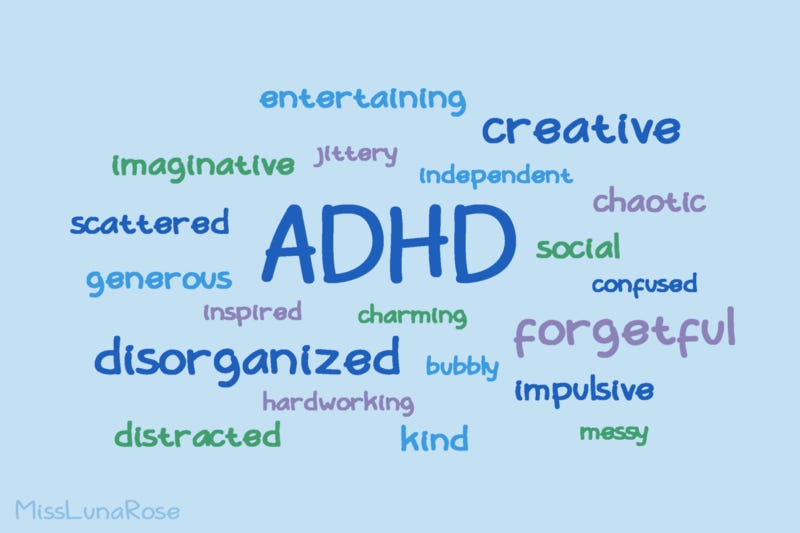
ADHD is associated with restlessness, impulsiveness, difficulty concentrating and generally challenging behaviour. Going out, organising themselves, following instructions, and other day-to-day activities can be a real problem for children with this condition. Difficulty sleeping and, again, anxiety are also associated features; and the condition is more common in children who have learning disabilities. There are, though, doubts over diagnosis and not unreasonable scepticism about what distinguishes everyday fidgeting and inattentiveness from ADHD. While symptoms tend to improve with age, there is something of a trend in adult celebrities being diagnosed with the condition - suggesting a strong cultural contagion element too.
I think this cultural element is part of a wider problem, as is the way that all children’s needs and the way they behave are seen through a therapeutic lens. Kids are never just being naughty. They are ‘communicating’ something. While this may be true, and is often true of children with special educational needs, I think we reach too readily for this particular framing of the problem. Not unlike with the lens of identity, there has been a proliferation of acronyms to describe conditions and problem behaviours. Indeed, this is the way we tend to understand our kids’ - and our own - problems these days.
This is frustrating because parents of SEND children do face considerable problems in helping their children live normal lives. They badly need support, but services and schools are starved of resources and expertise - a situation not helped by the expansion of the cohort. There is, though, information and independent support out there. The National Autistic Society is a great source of information and help on ASD; as is The Royal College of Psychiatrists on ASD and ADHD. Any parent battling their school or local authority over a lack of support or just wanting to get their child assessed, will find organisations like SENDIASS (SEND Information, Advice and Support Service), sen help, Special Needs Jungle and IPSEA (Independent Provider of Special Education Advice) invaluable.
We shouldn’t be making victims of ourselves or our children. We shouldn’t be projecting our sense of vulnerability, or our need for recognition of this or that identity, onto our kids. We are increasingly encouraged to disable ourselves and our children, to render ourselves deficient in ‘well-being’ (whatever that may be). But this isn’t helpful. Indeed, those of us with children with diagnoses and plans in place have done a lot of battling to get (or not to get) the support our children need.
But at the risk of being accused of pulling the drawbridge up, not all ‘neurodivergent’ children have a diagnosis; and not all special educational needs are amenable to medication or therapy. While our kids problems are not all in our heads, they may not always be in theirs’ either.
I will be speaking on school exclusions and children with SEND as part of The Great Expulsion Debate at this weekend’s Battle of Ideas Festival. Tickets still available.
Image by Miss Luna Rose