

I’m a David Bowie fan. After he died in 2016 - and as the world fell apart (if you believe those who long for pre-populist days) - I wrote about him. And about what we really had lost with his passing. Actually, Bowie was no fan of the EU and I imagine would have rather relished the so far dashed hopes Brexit represented. Nevertheless, eight years on, and a month on from the Battle of Ideas where I spoke at debates on neurodiversity and community, I’ve been thinking about how these seemingly unconnected events …. er, connect.
Bowie made an album back in the late 1990s called Outside (or, more accurately, Outside #1 to which there was no follow up). It was, to my ears, a welcome return to experimental form. I went to see him perform it, supported by Morrissey (also no fan of the EU). Anybody with a passing knowledge of his work will know Bowie created numerous personas from Ziggy Stardust to the Thin White Duke. For this album, he created and played a dizzying array of strange characters - perhaps anticipating today’s identity confusion. But he was also hinting at a desire to engage with a wider, albeit pre-millennial angst-ridden, world. Unlike his previous dystopian tales, he sang, ‘it’s happening now, not tomorrow’.
It felt like a venture outside of himself in to the immediacy of the now. In the first of those sessions last month, we discussed what might behind today’s cultish descent - particularly of young people - into damaging identitarian tribes. From the self-diagnosed neurodiverse to ‘trans kids’, their identity is very much centred on the self. In the second debate, we discussed how people had lost their sense of community and belonging and how we might rebuild it. As Bowie sang in the first song, of the same name, on that album,
It happens outside
The music is outside.
I may be reading too much into these two short lines - for which I blame Bowie’s indecipherable William Boroughs’ influenced ‘cut up’ lyrics. But, albeit belatedly, he was perhaps recognising that we can get lost in ourselves. We might not all invent characters or imagine ourselves as androgynous aliens, but we are living highly privatised lives and are encouraged to identify with different versions of ourselves. That’s really not an altogether healthy place to be. Instead, we should go outside where the ‘music’ is, where things happen. In short, we need to get out more. We, they, all of us, must step outside if we are to strike up a relationship with reality. Incidentally, Reality was the name of a later (not especially brilliant) Bowie album - which nevertheless suggested the direction he was heading in before his health took its first turn for the worse.
Isn’t it time we stopped identifying with that which makes us different and began identifying with that which lies beyond - or outside - the self? Wouldn’t it be better to focus on, and identify with, the collective, with those with whom we have something in common? While, as I said at last month’s debate, communities are (strictly speaking) things of the past - why aren’t we making more of an effort to build new points of association with each other? We can’t just sit back and watch our neighbourhoods - that ‘sense’ of community I spoke about - fall apart around us. Not only are pubs, and the social drinking culture peculiar to the UK, continuing to fall away - as Neil Davenport explains in his excellent pamphlet Pubs: Defending the Free House.
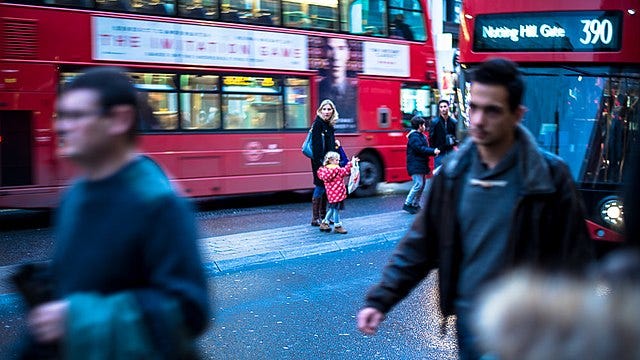
Every aspect of our local civil cultures seems to be in a state of collapse or disrepair. We are - to borrow a space metaphor from the creator of Ziggy Stardust and the Spiders from Mars - alienated from each other like never before. It’s as if we are, each of us, living on separate planets. That’s certainly what it can feel like when travelling around North East London where I live. The old hop-on, hop-off Routemaster buses, described as a ‘mobile community’ by Paul Burke in The Spectator, are no longer with us. Burke’s memory of his mother, a bus conductor, acting as a ‘conduit’ between passengers, feels several worlds away. But still, as Burke recalls his father saying,
‘Open the front door, and the whole world’s outside.’
The whole world is, admittedly, somewhat less amenable than it sounded then. But that is our doing. By neglecting the world outside our front doors, by neglecting each other - with our obsessive scrolling and our world-blocking-out ear pods - we have created not a sense of community, but rather a sense of a world collapsed in on itself. It is not just that our communities are gone - okay, not everyone lives in big cities - but we seem to not see ourselves in each others’ eyes anymore. Indeed, we barely lift our gaze from our phones. No doubt we have many advantages now, and times were hard then. But the mobile communities of the past at least helped each other, and felt like they had something in common even when they were complete strangers.
How do we do that today? How do we forge new connections with each other? Why aren’t we doing it already? Kim Samuel of the Belonging Forum, who I spoke alongside at the Battle of Ideas, describes ‘our disconnection from people, places, power and purpose’. She too wonders at the paradox of our ‘hyper-connected’ world that simultaneously seems disconnected. Our connections are shallow and transactional rather than meaningful. I don’t agree with Samuel that we just need to ‘create spaces’ in our local neighbourhoods into which people will flood. But I do think the absence of those spaces goes back to what I say about that withdrawal that has taken place, as we have retreated into our private spaces away from the crowd.
Nor do I agree with her that big cities are necessarily the issue here - as London’s ‘mobile communities’ of the relatively recent past suggest. But their populations have, as she rightly says, become more transient. And that inevitably compounds the deep disconnect we have with those around us. It is also true, as Samuel puts it, that ‘many people feel voiceless, disengaged from local and national politics, and unable to influence the decisions that impact their daily lives’. The rise of populism, and in the UK the vote for Brexit, gave expression to this sense of being ignored but so far, frustratingly, with little to show for it.
We still lack another dimension of her explanation for the crisis of belonging we feel. A sense of purpose or a feeling of being part of something bigger than ourselves. But what this ‘something’ is eludes us, and until we find it we’re going to remain stuck. Building community centres is all well and good, but in the absence of communities what are we going to fill them with? I like Samuel’s can-do ethos though. The ‘little things’ she is so passionate about do indeed matter and we need to do more of them. I also agree wholeheartedly with her that ‘now, more than ever, we need to prioritise social solidarity’. Absolutely, we need to abandon our identitarian tribes.
But saying we need to have a purpose and we need to pull together is to say nothing at all unless we know what our purpose is and around what we are to organise. Or, to go back to where we started, why would anybody want to identify with ‘communities’ with which they feel such a disconnect? What is going to get young people outside their own heads? Instead of floating in our tin cans, stranded in space like Bowie’s Major Tom, we need to get back down to earth and tether ourselves to the real world of sometimes messy, awkward social interactions. That is the only way we are going to build ourselves anew, and re-establish a public sphere of which we want to be a part, to which we identify and want to belong.
Image by Bernard Galewski
.jpeg)