

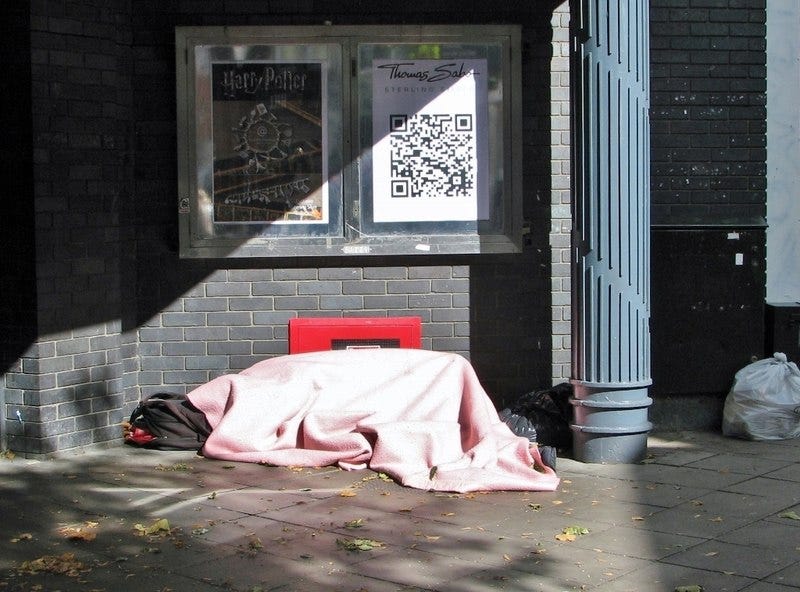
Despite the ongoing failure to build enough houses for us to live in, or bring down rents and prices in the horribly heated housing market, housing barely figured on the political agenda in 2023. Still, at this time of year, homelessness always gets a mention in the box marked charity. This year, we have the homeless charity campaign Crisis at Christmas, Shelter’s rather moving Good as Gold advert and the youth homeless charity Centrepoint with a more traditional appeal for donations over the festive period. These are all vital sources of support for people in acute housing difficulty or experiencing homelessness, but hopelessly inadequate given the scale of the problem.
Like the wider housing issue, it is both a complex problem seemingly forever unsolved, and yet (on the face of it, at least) amenable to straightforward interventions. I’ve made the argument before that direct payments, like those made to recipients of social care, would help many people. Still, I don’t underestimate the impact that personal circumstances can have on the capacity of some to help themselves. Nor do I underestimate the blanket-like suffocating complexity of the legislative and institutional arrangements designed to address the problem. A quick glance at the War and Peace scale Homelessness code of guidance for local authorities on how they should exercise their statutory functions, gives a sense of that.
Nevertheless, the government - over a year ago, now - committed itself to Ending Rough Sleeping for Good. That was then. Now, the talk is of the almost inevitable turfing out of the government before the new year is through. Still, it’s worth considering what it was proposing to do, and how that’s going. The strategy sets out multiple policies that I won’t go into, designed to meet 18 commitments, which in turn would deliver on four outcomes. These are to prevent homelessness, make various ‘interventions’, aid people in their ‘recovery’ from homelessness; and to make sure the system is ‘transparent and joined-up’.
So, there is some slippery use of the word ‘outcome’ for starters. One might have thought that the most important outcome, as far as rough sleepers are concerned, is getting them off the street and back on their feet. There is also a somewhat non-committal set of commitments. One is to ‘support our ambition that no-one is released from a public institution to the streets’. Is supporting an ambition to do something the same as committing to actually doing it? We’ll see how that went later. So what is the situation on the ground?
Support for people sleeping rough in England gives a useful extended snapshot of the months of January to March 2023. As many as 2,447 people were estimated to be sleeping rough on a single night in March. While this was 16% higher than the previous quarter, the winter months tend to see fewer people sleeping rough - not more. An interesting counter to the tendency for public sympathies to be roused for those sleeping rough in the run up to Christmas, at the very time a large minority of them are heading indoors and out of the cold.
Still, this year’s count represented an increase of over a third (35%) on the same time last year. As is typical, over a quarter (27%) of those living on the streets had not been observed sleeping rough before. And the overall figures for March were estimated at 6,292 people, an increase of 37% since the same time last year. This points to what the report describes as the ‘dynamic nature of rough sleeping’. From January to March, it is estimated 3,438 were moved, by local authorities, into medium or long-term accommodation. An increase of 17% on last year. And in March, 5,779 people were thought to be living in ‘off the street accommodation’. Indeed, as anybody who knows anything about homelessness will tell you, rough sleeping is only the sharpest end of a very pointy phenomenon.
The figures on statutory homelessness, for instance, concern local authorities’ duty to accommodate only those made homeless ‘through no fault of their own’, and in possession of a ‘priority need’. In practice, this means families or people with disabilities or mental health problems. Anybody else without a roof over their head is deemed to have ‘intentionally’ made themselves homeless, and solely to blame for their predicament. A harshness lessened just a little by the duties placed on local authorities by the Homelessness Reduction Act 2017, to try to prevent or relieve homelessness for non-eligible single people who may otherwise end up on the street.
Between April and June this year, 34,850 households were assessed to be threatened with homelessness and owed what is called a prevention duty. This was an increase of 2% on the same time last year. Of these, 6,640 (an increase of 10%) were serviced with a Section 21 notice to end an Assured Shorthold Tenancy. They were, in other words, about to be evicted. Another 38,810 households were assessed as already homeless and owed what is called a relief duty. This was up 7% compared with the same time last year. By the end of June, there were 105,750 households in temporary accommodation, an increase of 11%; those with children increasing by 14% to 68,070, and single households going up by 5% to 37,680.
So the figures from the early part of the year are disappointing to say the least. But as the season to be jolly cold bites again, are we any nearer ending the plight of those enduring it? Are things at least better than they were in March or in June as the streets became colder and less hospitable? There were 8,442 people living on the streets in September (the latest month for which we have estimates), an increase of more than a quarter (27%) compared with the same time last year. And 3,418 on a single night – up 18%. Of those sleeping rough in September, 2,663 (32%) were doing so long term - up 16% since June; and 1,048 (12%) were returning to sleeping rough – an increase of 5% since June.
There were 2,993 new people sleeping rough in September, over a third (35%) of all rough sleepers and nearly a quarter (23%) more than the same time last year. On a single night, 900 new rough sleepers were counted - over a quarter (26%) of the total and up 15% on last year. But surely the most striking figure of all - not least because it was one of the government’s commitments - is the 769 (or 9% of) rough sleepers who had left an institution.
That’s an increase of 43% since June.
Which rather brings home the point that, for all the efforts of those involved - be it central government, local authorities, charities, shelters and (not to forget) families, friends and kindly strangers - things have, in as far as they have changed at all, got worse. In some cases, much worse. I wonder who will be evicted next?
Image: Evelyn Simak
Thank you for sharing this really insightful read. Homelessness is on the rise for a lot of reasons (as you can see here: https://www.connection-at-stmartins.org.uk/facts-about-homelessness/) but we believe a lack of wraparound support is the biggest contributor because it means the root causes of homelessness are not being addressed on an individual level. -Sophie, The Connection at St. Martin's