From 'Year of Democracy' to Class War 2024
The return of the populists and the rage of the anti-populists

As it got started, 2024 was billed the ‘Year of Democracy’. More nations than anyone could remember - including us in the UK - would be going to the polls. As Mick Hume noted during the US election (the biggest of them all), this was not so much a celebration as a warning. An expression of elite anxiety about the people let loose on the important matter of electing the world’s leaders. They held their collective breath and wondered out loud how might they put a lid on the popular will? It rather confirmed that the big divide is not between the left and the right - as is so often claimed - as between us and them. Or as Hume put it: ‘the real threat to democracy today comes from above, not below’.
It wasn’t just the affairs of state, or the messy business of giving state actors a whiff of popular legitimacy through the ballot box, that brought out anti-masses prejudices. These attached themselves to all manner of events, and were expressed in the petty snobbery of the cultural elite,
It’s no coincidence that Oasis are the band of choice for flag-shaggers and Reform voters – it’s remarkable how often their fans have the butcher’s apron on their Twitter bios, just as Noel had it painted on his guitar.
So said music journalist Simon Price. When everyone else was getting excited about the Gallagher brothers patching up their differences for a few sell-out shows, Price’s hatred for them and particularly for their fans couldn’t have been clearer. Brendan O’Neill, one such fan and chief political writer at spiked, had this take on the,
… chattering classes … worried these ‘grunting’ lads from inner-city Manchester might upend the ‘introspective, ruminating’ pop fashioned by the fine fellows they once boarded with.
Much the same sentiment could be found as England exited Euro 2024 . The sophisticated ‘soccerati’ as O’Neill described it, began ‘spitting snobbish bile at the somewhat podgier, more follically challenged blokes in the stands’. His colleague at spiked Fraser Myers asked why, post-Euros and post-riots, the ‘anti-fascists’ of Stand Up to Racism felt the need to protest outside a Wetherspoons? This time it was football fans on a fuel-stop before a game, again in Manchester, who were confused by these clueless bigots with members of the English Defence League. While being subject to middle class rage seemed to take the form of annoying drumming, as one fan tweeted,
[You] can’t even have a pre-match pint without being called a racist.
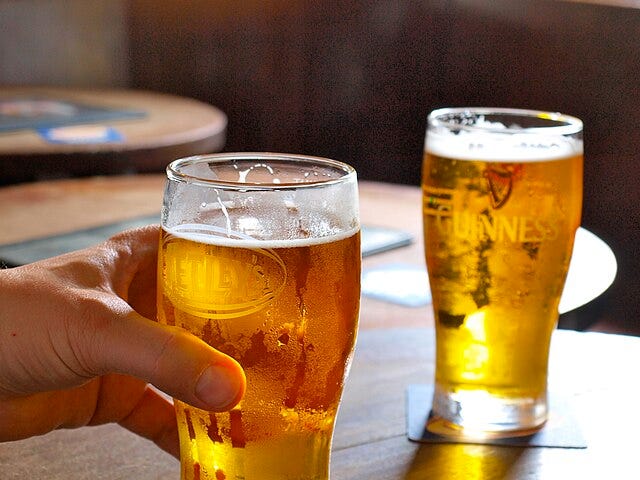
The association of drinking beer with bigotry is an irresistible slur for the chattering classes. Its as if they imagine every pub, outside which they would rather remain jeering, is full of Tommy Robinsons with a liking for hooliganism and brimming with Islamphobia. According to progressive protesters, says Myers, ‘every working-class person is just one pint away from committing a hate crime’. Which is perhaps why, as spiked editor Tom Slater had it, the authorities too are drunk on authoritarianism when it comes to keeping a tight leash on the kinds of people who frequent pubs. It seems to me that these attacks on the working class, often by privileged activists and commentators, were a central part of the culture war this year.
There’s something brewing and they really don’t like it. And who can blame them. At The Spectator Parliamentarian of the Year Awards, Nigel Farage - leader of Reform UK - accepted his (surely tongue-in-cheek) Newcomer of the Year Award with these words:
We are about to witness a political revolution the likes of which we have not seen since Labour after the first world war. Politics is about to change in the most astonishing way. Newcomers will win the next election. Thank you very much.
It has taken on many forms in the years since 2016 - or post-Bowie as I described it in an earlier piece on here - but populism is back. In truth it never went away. To the great alarm of the elites, despite initial set-backs it has become a force in world politics again, and like over-coarse hair that has been over-plucked, it has come back stronger - over-turning governments (particularly post-pandemic) across Europe, in the UK, even in Ireland, and across the Anglosphere. Across Europe particularly, tractors have been turning up where they’re not supposed to be, as ordinary rural folk join their urban and suburban cousins in a kind of revolt.
We can do to the farmers what Thatcher did to the miners.
So said former Labour political adviser John McTernan during an interview on GB News, as protesting farmers took to the streets. They may be sitting on vast wealth in the form of the land and machinery that allows them to produce the food we and others eat. But they also face ruin if subject - as many will be with a threshold set at £1 million in assets - to inheritance tax. As Gus Carter, writing in The Spectator, explains - the government’s own figures show that ‘almost one in five farms make a loss, while a quarter made less than £25,000 last year’. In other words, despite a large number being paper millionaires, they are actually struggling to make ends meet.
This is part of a wider war on the countryside dating back to the Blair government’s targeting of the toffs on horseback. Of course, the hunting ban then, and its bizarre expansion with proposals to ban hunting without any actual animals now, was never about animal cruelty as they claimed. It was a sectarian attack on ‘the other’ as leftish academics might describe it if they themselves didn’t so welcome it. Not that it was ever just about the rural rich. It was a very deliberate assault on another people’s way of life - as if the country and the country were two different things; but also on all our freedom to do as we choose. As the decades since the dawn of New Labour have shown.
And so populism is taking the form not just of a movement of those impacted by urban collapse and neglect, but also one being driven by the anger and the interests of those who look after the land. Tax the asset rich and the cash poor is their cry. That’s what makes it a class and a culture war - it’s an attack on people’s livelihoods and the ways of life of entire communities. Both are targeted by the workerist-technocrats of this new government. Not that they’re especially bothered with privelege as such. They are more than happy evicting elderly aristocrats from the Lords. And happier still to fill it with ‘experts’. And in no rush to abolish the House itself. Likewise, they have entered into a corporatist embrace with the representatives of Big Business.
It may seem that they hate nothing more than a populist like Trump or Farage. But, actually, they hate the populace more than they hate the populists. Whether they’re Brexit voters in the old Red Wall or farming families in England’s rural heartlands, both are little understood by our political and cultural elites. It is because it is these people that the populists are trying to appeal to, that they are treated as such a problem. The technocrats who run the country hate them only in so far as they they claim to represent those who produce stuff against those who … do what exactly?
As the author and social commentator Frank Furedi explains,
According to the anti-populist narrative, populism is the pathology of the simple-minded masses, those who are apparently predisposed towards authoritarian, xenophobic and anti-democratic sentiments. They are what Hillary Clinton called the ‘deplorables’.
But in truth, it is the threat to the ‘political culture of the elites’ that drives the culture wars. Whether its farmers threatening to bring the stink of slurry to the doorstep of No.10 Downing Street in opposition to a tax that, according to Tim Black, demonstrates how ‘utterly, wilfully oblivious to the reality and necessity of productive work, of material production, and the communities that rely on it’ this government is. Or the UK’s perverse war on fossil fuels and even its own car industry, rapidly turning the country that started the industrial revolution and created the modern age, into a tragically green-flecked, deindustrilaised fuel poor dependent.
Whether its protestors and commentators complaining about English working class holidaymakers; snobby comments about lads in Manchester - whether out for a pint or having a blokey stage persona; or the political and media elites’ incomprehension and feeling of ‘betrayal’ at the result of the US election; it is becoming increasingly obvious that the culture war is, in the end, a class war. O’Neill has observed how the run up to the US election confirmed the Trump derangement afflicting the elites had not gone away. They ‘still view his voters less as rational beings to be engaged with than as a far-flung tribe to be studied’.
Back in the UK, ex-footballer, Gary Lineker went from national hero of the people’s game to deranged detractor of all things populist. And finally saw him losing his jawdroppingly lucrative Match of the Day day job. A sign of the times perhaps? Then again, Greg Wallace. As Rod Liddle put it, with all that was going on towards the end of this year, it was rather striking that ‘the top story was that a Millwall supporter [i.e., Wallace] had upset some women with a few ribald or coarse comments’. You don’t have to like the grocer turned TV presenter to see the how the distaste of the elites for certain behaviours and attitudes had an outsized impact on public discussion. Or how attempts to portray people’s everyday concerns or lifestyles - be it their views on immigration or having a flutter - as a problem to be solved, was itself a problem.
As Joel Kotkin rightly observed during the US election, ‘culture warring alone can’t meet the economic aspirations of the masses’. Still, there is a genuine move against progressivism and a progress towards something else. Something (hopefully) better. We haven’t got to ‘roll with it’ anymore. The world is changing. The deplorables will soon be in charge in the US and that’s creating waves across the ocean. But the capture of our institutions - or what would be more accurately described as their self-capture, given those running them have long ago forgotten what they are for - has been so widespread and profound, it’s going to take some time to undo. It’s not just Extinction Rebellion and Just Stop Oil that have lost their minds.
Green ideology is deeply embedded in our institutions too, leading to a neglect of, or even hostility to, the economic growth on which all of our material wellbeing depends; and the very real prospect of power cuts and blackouts. The government - having made positive noises about the importance of growing the economy during the election - has done nothing since taking office to suggest it has any intention, if it ever had a clue, of doing so. Far from re-creating the dynamism that changed the world two centuries ago, it seems the only thing we’re world beating at today is electricity prices. That and the expansion of the university sector. According to Furedi, we are over-producing increasingly bored ‘disinterested students’ rather than creating the ‘world-class system of apprenticeships’ we so badly need.
There is much policy orthodoxy to challenge and overturn. The ruling classes with their luxury beliefs, language codes and safe spaces - each created in those self-same institutions - are relatively unaffected by the social and economic consequences of their bad ideas. But for now, with the arrival of 2025, we could do worse than adopt the Gallagher brothers’ swagger; and develop a new self-consciously, self-interested politics fit to take on the many and deep challenges our societies face. That’s going to mean taking people seriously. Democracy isn’t a threat. It’s an opportunity to recreate the world in our own image. This was the year in which so many of us went to the polls and started to change things for the better. Good. What’s next?
Image by Simon Cocks
