

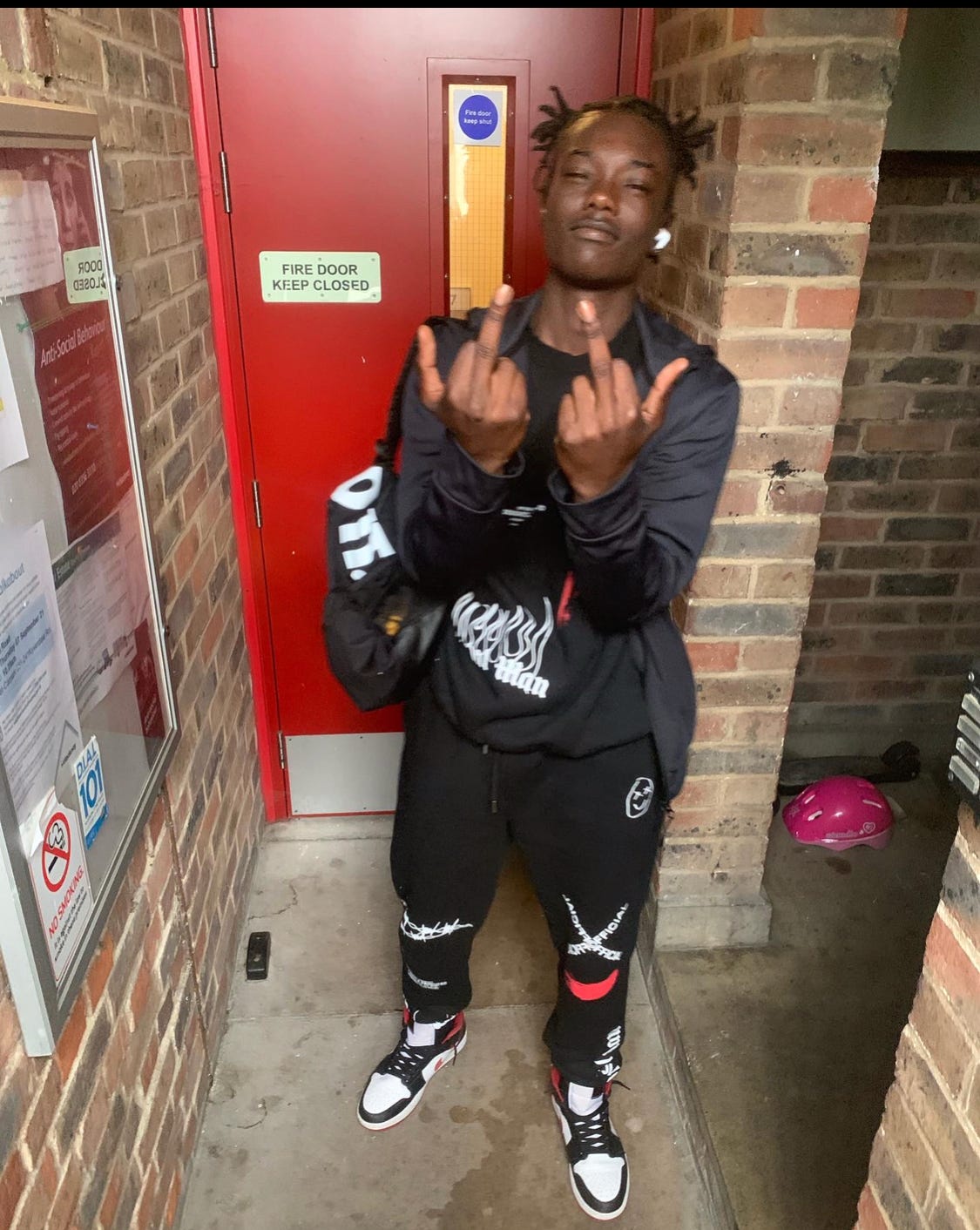
BREAKING NEWS - Mizzy (remember him?) has earned himself an 18 week stretch in prison. The ‘Tik Tok prankster’, said the judge as he sent him down for not very long, ‘claimed on national television the law was weak’. I rather suspect the two year social media ban will be more of a challenge for a young man ‘motivated by your desire to be famous’ and oblivious to the ‘significant harm and distress’ his antics caused unsuspecting members of the public.
I chaired one of the opening debates at last month’s Battle of Ideas in Westminster, called From Mizzy to Shoplifting: Anti-Social Society? This wasn’t the original title. Initially, the hook for the debate was just Mizzy and his house break-in stunts. But then there were the disturbances in Peckham, following an alleged shoplifting incident that went viral. And then October 7th happened, and everything was thrown into unimaginably horrific relief as ugly anti-Israel protests went viral. I called my promotional piece for the session From Mizzy to the Middle East? in a nod to this grim extension of the realm of the anti-social. A huge march was happening just down the road. Police helicopters circled overhead as we debated.
But, despite all this, the core questions I wanted to explore remained the same. What’s going on in our communities? Are we less civil than we used to be? Are adults too anxious or just too indifferent to do anything about youthful misbehaviour in our communities? I had a great panel of speakers. Francis Foster, teacher, comedian and co-host of Triggernometry; was joined by Emma Burnell, journalist, playwright, and founder and political consultant at Political Human; Ed Rennie, Catholic writer and political strategist; and Lisa Mackenzie, working class academic and author of Getting By: Estates, Class and Culture in Austerity Britain.
Mackenzie took us back to the late 1990s and how New Labour invented the ASBO yoof, as class politics went into decline and identity politics took its place. Burnell wasn’t convinced we have a particular problem with anti-social behaviour, or at least no more than in the past. It’s ‘just bored kids’, another ‘panic about teenagers’ she said. (Though she also suggested a lack of resources and ‘spaces for them to come together’ might have something to do with it). Foster disagreed. For him, the problem of anti-social behaviour is a very real one, attributable to fatherlessness in particular and a wider crisis of masculinity. Rennie went further back than Mackenzie, tracing back our ‘heading to a more anti-social society’ to the decline of Christianity particularly after the First World War.
While I think Mackenzie was right in her characterisation of the narrowing of the political sphere away from the structural and towards the identitarian, and agreed with Burnell that society must invest in young people if it is to foster the kind of behaviour we expect of them, I think Foster and Rennie were right to observe that something has gone seriously wrong in our culture. I liked that Rennie, nevertheless, held out some hope for the future. We must resist the social pessimism of our times. He talked about the importance of having a ‘sense of ethics’, something that ‘binds us together’ and asked whether this is something we can ‘refashion’ today?
As we opened out the discussion to the audience, there were points about the breakdown of discipline in our society, but also the breakdown of community and how, as one audience member put it, if she misbehaved as a young girl ‘by the time I got home somebody knew’. For me, this spoke not only to how social change has fragmented communities - a perhaps unavoidable feature of modernity. But also to the way other adults once felt a sense of obligation to each other in a way that we simply don’t today.
An ex-Marks & Spencer employee told of how they were told ‘don’t intervene’ should they spot a shoplifter. While Burnell and Mackenzie explained shoplifting - which has risen by a quarter in just a year - as another instance of people in desperate poverty forced into desperate measures, I was struck more by the corporate endorsement of those robbing them of their stock. Finding much to object in what he regarded as Burnell and Mackenzie’s seeming apology for theft as a response to immiseration, Foster described their position as ‘morally abhorrent’. While I tend to agree, I do think its helpful to try to understand what’s going on here.
Rennie wondered at one point in the discussion, ‘do people care enough about what is going on?’ In a world where, as Mackenzie put it, ‘personal identity becomes more important than community’, are we lacking the moral muscles to do anything about petty crime or anti-social behaviour? Are we too scared, as somebody suggested, or are we just scared of what people will say? One woman, a little self-consciously, spoke of her experience living in a London where newly arrived migrants - ‘people with very different values’ - are impacting on the local’s (particularly women’s) quality of life. On the other hand, we heard how young people are seemingly aimless and anxiety-ridden, spending ‘too much time online, not enough time in the world’. That would be on us.
Talking of young people, I think Kevin Rooney, chairing The Great Expulsion Debate, may have inadvertently stumbled upon the unofficial theme of the festival. I was speaking in this final slot of a fascinating, exhausting weekend - you can read my speech here. One of my co-panellists, Dr/Lord Tony Sewell MBE, as well as being chair of Generating Genius, The Sewell Report and former chair of Race and Ethnic Disparities Commission, was a founding governor at the Michaela Community School. Officially Britain’s best performing secondary school, despite being situated in ‘deprived’ working class Wembley, the school is run by the wonderful Katharine Birbalsingh, (un)popularly dubbed Britain’s strictest headteacher. Rooney, also an admirer, nevertheless finds himself floating between the polls of freedom and order when it comes to school discipline. Which is why he could never send his own kids there.
Frankness is a quality I appreciate, and Kevin has it in spades. As he said when he first approached me about the debate, and as he repeated at Church House (the wonderful venue we spent the weekend debating in), he finds the disruption associated with some children with special educational needs (SEN) in the classroom to be ‘a nightmare’. It is increasingly the case that violent outbursts, and the safety and learning experience of other children are a big problem for many schools. As a governor, I sympathised with the former headteacher who asked can SEND children be ‘held accountable’ for their outbursts?
However, as the parent of an autistic child, I know that if such a child is having a meltdown, there is very little they or anybody else can do about it. They are, as I put it, ‘not there’. Meltdowns can be distressing. A child can be so absent, communicating with them becomes as impossible as it is inadvisable. Too often these children are excluded when the circumstances leading up to an ‘incident’ are foreseeable. With the right support or in the right environment the child wouldn’t get to this point in the first place. And yet, for the children behaving in this way and through no fault of their own - their safety and their education come second place to that of their peers, if they feature at all.
One audience member raised how parents are often ‘not accepting of a SEN diagnosis’. Another, more cynical, suggested parents use their child’s diagnosis or SEN status ‘as a way of trying to get extra help’ rather than accept that theirs’ is ‘actually a naughty child’. There is truth in both accusations. Some children would benefit from better socialisation or more discipline, rather than a SEN label, therapy or medication. But also no parent wants to think their child has something wrong with them. And yet, as time goes by, their child’s behaviour becomes an issue, and they are repeatedly being excluded from school, parents can become more forthright in demanding their child gets the support they need. This often means getting a diagnosis.
One mother spoke of the great progress her severely disabled child had made since moving her to a school for children with life limiting conditions. ‘These kids are different’ she said. We need to be ‘making a SEND school a positive thing’ and not ‘treat them like a victim’. Interestingly, her point was not so much that schools can be too demanding for these kids, but that (in their own way) these schools can stretch those with even the most disabling of disabilities. She praised the school and a particularly tough teacher for pushing her child to achieve so much. I found her words inspiring. It’s easy for parents to accommodate to the low expectations of a schools system that is failing them.
‘Children love structure’ argued Sewell. They ‘respond to that, particularly where the parental situation is breaking down’. I was worried that I’d sent the discussion down the SEND route, whereas he was talking particularly about Caribbean and other under-achieving kids. Sewell was making the case for a ‘great family preparation debate’ in which, rather than blaming everything on poverty or racism, the importance of family background is to the fore and prevailing attitudes to hierarchy and structure are addressed. This was such an important point. So I needn’t have worried. Those kids who struggle with their behaviour, for whatever reason, benefit all the more from such things. There was a coming together, I think, on this point.
Still, we have to be careful. If schools are becoming less accommodating of the kinds of behaviour that can get SEND (and other) children excluded, then it matters little what ethos schools adopt. My co-panellist Michael Merrick, director of schools, Diocese of Lancaster; former teacher; education and social commentator, corrected himself when he used the word ‘restraint’. That ‘is not the right word’ he said, opting for ‘support’ instead. But we shouldn’t be adopting euphemisms to tiptoe around the stark reality of what the school experience can be like for these children. These incidents can be violent, both in terms of the child’s lashing out and with regards the response of the adults. They are forcefully held down. Whatever the rights and wrongs of it, they are being restrained.
We need to better understand why kids are excluded from school. The ‘constant push for the mainstream’ isn’t working, said co-panellist Stella O’Malley, (psychotherapist; director, Genspect; and author of What Your Teen is Trying to Tell You). She talked about the rise in diagnoses and the ‘deep distress’ some of these children experience, but also the ‘coldness and disassociation’ of their peers. It clearly isn’t doing either of them any good. Rather than relying on larger factory-like schools we need a ‘greater variety of school types’ including ‘smaller primaries’, she argued. Absolutely, and I rather agreed with Merrick on the need to revisit ‘what we mean by inclusive’, and do more to support these young people much earlier.
I didn’t wholly agree with O’Malley’s criticism of the notion that ‘education fills all holes’ though. While children do lack a sense of meaning and purpose, I’m far from convinced that the ‘great God of education’, as she put it, is the problem. Especially when even the ordinary demands of education, asking young people to do things they’d rather not (such as study for their exams), are discussed as if they were a form of abuse. Rather, it seems to me, the over-application of a therapeutic ethos is having a corrosive impact on children’s experience of school, by undermining their willingness to engage and learn.
We might be in a better way if education were worshipped like a God, and all our children were treated to a good, and academically challenging education. But it is true that education is overburdened with a whole host of issues it is ill-placed to address. As one audience member said, 'the system just can’t cope with these kinds of problems’.
Are we raising a nation of Mizzys or is there more to the behaviour problems we are seeing in our schools and beyond? Allowing schools the freedom to work out how they educate and accommodate children with challenging needs and behaviours, and how they go about asserting their authority, is perhaps the way to go. In both debates, the themes of structure vs culture featured strongly. Is anti-social behaviour a consequence of social disadvantage or an expression of a cultural malaise? Are schools excluding more kids, especially SEN kids, because of a lack of the right models and resources, or are wider cultural trends making themselves felt in the classroom?
Of course, this only gives you the slightest taste of what you missed. There were many more debates throughout the weekend. I attended other discussions, for instance, on the nanny state, the role of the state in the economy, populism, the right to smoke, and sex and drugs and rock ‘n’ roll. The weekend ended, as I think it usually does, with a sense of deflation. This is not a bad thing. Its a testament to how important these weekends are in the calendar.
It’s the come down from the intellectual ecstasy of intense debate, and acclimatising back to a disappointing reality where few really care for such things. But I was more down than usual. I wasn’t happy with myself in that last session. I was garbled, and too invested in the issue to think clearly. Instead of pursuing the themes that I had begun to explore in my introductory remarks, I was the angry parent surrounded by experts, trying not to get worked up. But I should perhaps have taken heart from those who came up to me at the end.
‘We try really hard’, said the frazzled teacher, apologetically reeling through the multiple plans and visual timetables she has to juggle in order to support the SEN kids. Now I felt sorry for sounding ungrateful. ‘It all made sense’ said the young man with autism, who appreciated hearing from a parent’s perspective. I hope I did it justice. It was great to see Father Ted creator, Graham Linehan, at the back of the room. He’d been at the festival all weekend, and was there right at the end chatting away with punters at the drinks reception. That’s one of the great things about the Battle - everybody mingles. Half the time you don’t know who you’re talking to.
I tried to mingle too, having abandoned doing so the night before, blaming an unfinished speech and an anti-social tendency of my own when faced with a boozy, crowded room of still energised battlers. I bounced awkwardly between them, catching a few words with familiar folk here and there. But I was on my way out as the Hooligans, featuring GB News’ Liam Halligan and his talented fiddler daughter Maeve, got going. As I took off for St James Park tube on the street below, the jubilant sound of Traditional Irish music leaked out into the night.
Maybe I’m projecting my own introversion onto everybody else, but too many of us live privatised lives, and have no part in these conversations. How do we grow this battling over ideas into the everyday, into our communities where they are needed the most? As the perverse ‘pro-Palestinian’ protests continue, its good to know that this coming weekend, at least, there will be both a National Solidarity March Against AntiSemitism in London and another Battle of Ideas in Buxton. Tickets are still available for both of these important events!
Image: Mizz2waveyy [himself]