

We talk a lot about identity these days - gender identity, racial identity - even, as I’ve been exploring recently, neurodiverse identities. But we don’t talk nearly enough about our national identity or identities. As I’ve discussed before, our starting point is a rather confusing one - with what the historian of Tudor England and political commentator David Starkey describes as our particular ‘biculturalism’. Am I English/Scottish/Welsh/Irish or British? We have a kind of built-in identity crisis with centuries old roots. But the crisis runs deeper than an accident of our birth.
As Starkey has also observed, officially - for decades now - the line we’ve been fed is that we only have two values - toleration and diversity. ‘In other words, we’re nothing’. A point elaborated on in a lecture on Why Britain is Broken and How to Fix it, ‘A thousand years of history are reduced to two bland abstract nouns’, he argues. And yet this evacuation of meaning from our national identity, as pronounced as it is on this damp and deteriorating island, is not necessarily peculiar to us.
In a talk entitled The Rise of Western Art & Culture, he draws our attention to the contrast between the fact that, in a very material sense, we are living ‘the best lives’ that were ever lived anywhere. And yet, ‘the sense of aimlessness, of formlessness, of pointlessness is overwhelming’. It is, he says, for all our riches, ‘pretty much Rome 410’ for our civilisation. He’s right of course. Indeed, that very word - civilisation - is rarely uttered. We can hardly come to its defence if we can’t even say it.
We talk, instead, about culture. But we don’t dare compare one with another. That the leader of the opposition Kemi Badenoch saying ‘some cultures are better than others’, could be received as somehow controversial, rather than a statement of the obvious; only points to the depths to which our culture/civilisation has fallen. There has been welcome outrage that our centuries old jury trial system is under threat from the technocratic bean-counters more concerned with arresting the backlog than administering justice. But very few are as outspoken about the sharia courts that operate in this country as an almost parallel system of justice for some.
For Peter Whittle, founder of the New Culture Forum who sadly died this week, ours is a two tier society. A term coined in response to the prime minister’s mishandling of the ‘riots’ in Southport last year. As the author and social commentator Frank Furedi argued, there was an underlying sentiment felt by many at the time. A feeling that they were being ‘dispossessed of their cultural legacy and way of life’ and that they ‘have no place in a world where Identity is everything’. As Whittle suggested, it wasn’t just about an increasingly partial police or court system. There was a wider sense in which the political priorities pursued in parliament were felt not to be being pursued on behalf of us, but in spite of us.
Writer and trade unionist, Paul Embery, commenting on the summer protests triggered by events surrounding the troubling presence of ‘migrant hotels’ in the Essex town of Epping and elsewhere this summer, traced developments back to,
… the disorientation and bewilderment caused to my fellow citizens in Dagenham by the effects of the new global market, especially the rapid and large-scale deindustrialisation and demographic change that began to take hold in their community.
That feeling is still simmering. We are expected to celebrate the atomisation and fragmentation that has accompanied the changes Embery describes; and to distrust wider solidarities around that which we hold in common. Is it any wonder that many feel they don’t belong or feel confused and vulnerable, or that some are prone to lash out - however wrong or misdirected that may be? It is perhaps in this context that the controversy over mass immigration and leaky borders needs to be understood. Unprecedented and impactful on communities, poorly managed and unaccountable to the electorate, as the policy (or lack of one) currently is; there is more to this than the particulars of the ‘small boats’ or legal migration issues.
While we may be better off than those that lived on this island, or in the West, before us; there is, at the same time, economic stagnation, political chaos, and a general sense of institutional decay with which we have become all too familiar in recent times. But this is symptomatic of what can only be described as an existential crisis. We don’t know who we are. That clambering for a national identity, or a unifying idea or belief or value, is the absence into which everything else is sucked. The unease over uninvited strangers in our midst, however justified it may be, has become a lightning rod for a pre-exiting discontent with and within our national community.
As with the national identity crisis, the experience of immigration is not peculiar to the UK. As President Trump put it, ‘Europe has gone through a lot of problems, and a lot of it’s having to do with immigration’. But real enough as the problem is - I can’t help feeling that it is a secondary issue. The biggest problem we face is not unrelated, but there is far more to it than too many people coming from the wrong kinds of places.
I don’t mean to underplay the deep challenges we face at the level of demographics and culture. Too many are too scared to say as much. ‘We escaped, but they are now here’ British Iranian Mahyar Tousi’s mother said to him after leaving Iran, after 7/7 and the Westminster Bridge attacks. Tousi recounted this to those who had taken to the streets of London, for once in defence of Israel and the Jewish people who have found themselves subject to hate in the UK post October 7th. But, as Tousi made clear in that speech, the Islamism from which that hate has sprung has been with us a while.
As Rob Killick argued, following JD Vance’s Munich speech …
These wokeists have allowed and encouraged the vilification and suppression of views they do not approve of, they have encouraged the growth of the divisive politic of diversity, they decry and denigrate the nation state, and they have suppressed recognition of and opposition to the internal threat to our societies from Islamism and its supporters.
Islamism is not the same as Islam, of course. While not without its challenges - like the ‘Burka’ ban controversy that became such a troublesome issue in parliament earlier in the year - I don’t think Islam is quite the mortal threat to Western civilisation it is sometimes made out to be by some on the right. Having said that, it is hard to assimilate traditions into the host culture when we’re not all that sure what that culture is. It is only by talking and disagreeing about it - as happened at a fascinating debate on this very question at the Battle of Ideas last month - that we might better understand the threat, if that is what it is; and, in the process, better understand who we are as a people.
For instance, I disagree with Rupert Lowe, formerly a Reform UK MP, on his call for the banning of Halal and non-stun animal slaughter. While, as a farmer, his concern is animated by the increasing use of what he regards as a cruel method of killing animals for Halal meat; he also calls for the banning of Kosher meat. But it seems to me that in a free society, regardless of our concerns for other creatures (which I share), we should put freedom of religious belief and practise above that of animal welfare (and above any distaste for what a few Muslim women wear).
But he is right to raise the issue. As he says, millions of people in the UK are ‘unwittingly’ consuming Halal meat. If, instead of calling for the banning of a religious practice, we demanded the labelling of all meat produced in this way, this would lessen the extent of the suffering these animals undoubtedly endure, while protecting what are, I would argue, two fundamental British values - freedom of religion (or the value of ‘toleration’ about which Starkey was too dismissive) and freedom of choice.
There is a genuine sense of foreboding about our current state and what the future holds. You only have to scroll through the daily feeds to get a feeling that the UK is in a state of deterioration, a slow collapse and disintegration of that which holds us together. In my darker moments, when I look around me and see people from a variety of ‘communities’ each of them living their parallel lives, is it really all that far-fetched that a kind of civil war, as some academics would have it, could break out? We’re not at each others throats, but I do sometimes wonder what is holding us together? This is not just a question for the multi-ethnic neighbourhoods in which I have happily enough lived and worked most of my life.
It is a much deeper question about the kind of society we want to live in. The right - to the extent that the word holds any meaning these days - is right to be concerned for the future of our way of life. But I remain optimistic. I was in the West End on Budget day last week. The headlines were all about the row between the Office for Budget Responsibility (OBR) and the Treasury, over the mysterious ‘black hole’ that opened up all of a sudden like one of those sink holes you see cars disappearing into. But it was the convoy of tractors, blaring their horns and playing vaguely familiar techno tunes as they ploughed through the capital’s streets, that inspired me with their noisy resistance against a government determined to tax farmers off their farms.
If we’re going to work out who we are, and find some optimism in these troubled times, who better to look to than those literally looking after the land we call home?
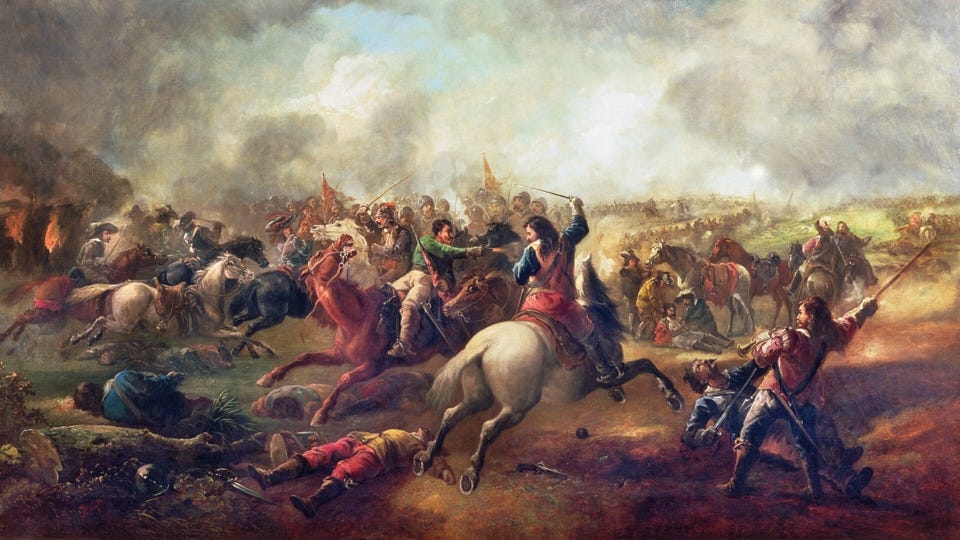
Image: Battle of Marston Moor 1644 by John Barker
