

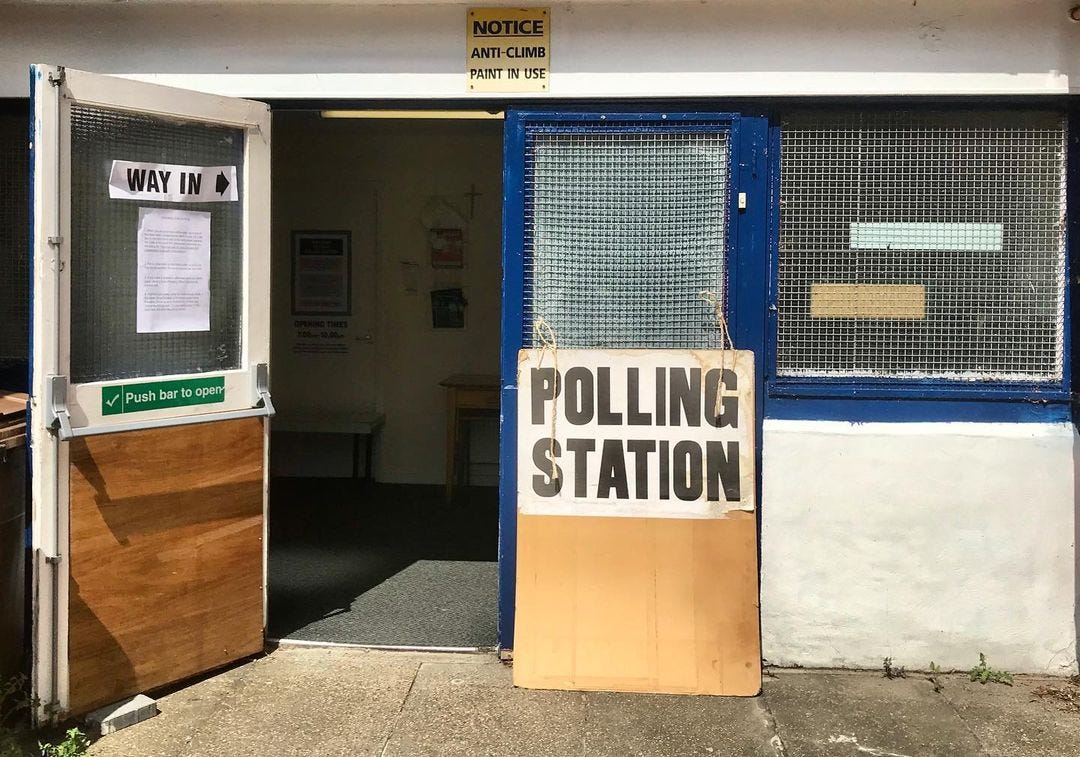
With the local elections almost upon us, and in the spirit of public service, I thought I’d say a little about the workings of local government. This won’t be a political commentary. Public servants are in a period of what used to be called purdah - a time of political sensitivity when they need to watch what they say.
(Ironically that word is very much frowned upon now. So even the word used to describe watching what they say before an election, is now effectively banned because they must now watch what they say all of the time. Not just during what is now simply known as the ‘pre-election period’.
Supposedly because it offends those, among some Muslim and Hindu communities, who practice the seclusion of women. Not, correct me if I’m wrong, out of any concern for the women kept in this state of purdah. Either way, what was a phrase in common usage across government until very recently, is now no longer heard.)
The size and complexity of your average council means that even those of us who have worked in them don’t know them perhaps as well as we should. If you spent a couple of decades working in children’s services or social care, as I did, you’re highly unlikely to have anything to do with refuse services or the planning department.
In other words, your average local bureaucrat - like most citizens - has only a partial, and somewhat shaky, understanding of the way local government actually works. So, for all of us, how does it work?
The most notable thing about local government is that it comes in different shapes and sizes. There are county councils, 21 in total, with 164 district councils sitting beneath them. They operate as two-tier areas. There are also unitary authorities, metropolitan districts and there are the London boroughs.
There are 62 unitary authorities, mostly spanning large urban areas, providing all the services in their locality. There are 32 London boroughs, complemented by the London-wide government of the Greater London Authority. And there are 36 metropolitan district authorities, covering Greater Manchester, Merseyside, South Yorkshire, Tyne and Wear, West Midlands, and West Yorkshire.
In addition there are around 9,000 town and parish councils that tend to provide smaller scale local services even than the district councils. There are also ten combined authorities - that is, local authorities acting together with devolved powers. Finally, the City of London Corporation and Isles of Scilly are different to all of the above, attending to the particular needs of the ‘Square Mile’ and the inhabitants of those lovely rocks just off the Cornish coast.
The governance arrangements for each can vary, but typically they are made up of either a mayor and cabinet executive, a leader and cabinet executive or of the traditional committee system. Councillors - or Members, as we local authority officers always used to refer to them - are elected by residents for 4-year terms. If you are wondering why you’ve not had a leaflet through the door yet, its because the electoral cycle is such that not all councillors stand for election at the same time. (You can find out more about that here).
On 4th May, elections will take place in over two thirds of England’s councils.
Councillors - one, two or three of them - will be standing for election to areas known as wards or (in the counties) divisions. And these, whatever rosette they wear, are the most important people of all. They are the ones, our representatives, on whom all of these structures are built. They are the ones who, on our behalf, make decisions about the communities in which we live.
There’s another substack I could write about the sorry state of local democracy. But we’re in p-p-pre-election period.