

Leo Kearse, comedian turned political commentator, recently tweeted: ‘Autistic people sometimes can't help but be blunt and factual’. Qualities that I would argue, in these double-speaking, reality-bending times, are sorely needed. Perhaps it is fitting too that some of the sharpest political commentators around today - Konstantin Kisin, Andrew Doyle, Volodymyr Zelenskyy - used to be comedians. You need a sense of humour, a feel for the surreal, not to mention an ability to cope with the hysterical, to make sense of the world.
Kearse was referring to a particularly ugly incident involving a, for once aptly named, force. All too often the police think of themselves as a ‘service’. They don’t want to sound too authoritarian. Even if they are. Some might say they’re not much of a service either. As their failure to solve, or even turn up for, some of the most petty of crimes suggests. Having been asked to escort her back from Leeds Pride (to which she had ‘sneaked out’ to join her older sister), seven West Yorkshire police officers went on to forcefully arrest and drag an inebriated, 16 year old autistic girl from her home.
This was despite her crying, cowering and having a meltdown in a cupboard, and her mother repeatedly explaining the obvious distress they were causing her. She subsequently spent many hours in a police cell for innocently saying one of them was 'a lesbian like nana'. And has since been released without charge, though not without an official complaint after the incident was posted on Tik Tok. (Not everything on social media is bad. For every idiotic anti-social Mizzy there is a concerned parent or citizen journalist exposing the misdeeds of the powerful for all to see.)
Which brings me to the Mayor of London, Sadiq Khan. He has recently appointed Maureen McKenna, the former Director of Education at Glasgow City Council, as a consultant to the city’s Violence Reduction Unit. Her mission is to reduce school exclusions. McKenna is a controversial figure. As Lara Brown, writing for The Critic, explains. McKenna’s view that the violent outbursts of some children should be understood rather than punished, and her opposition to permanent exclusions as a solution, presents problems for schools. While I am more sympathetic than Brown, the contrast between this approach and that of West Yorkshire Police is striking.
In our topsy turvy world, hateful words are deemed to be more harmful than violent actions. As Brown acknowledges, Mckenna succesffully reduced exclusions in Glasgow by 88%, but not without further violent incidents. There is no easy solution one way or the other, it seems to me, to address the problems in the classroom that can lead to a suspension or exclusion. It is wrong, of course, that a few children should disrupt the education of a larger number of classmates. But it is also wrong that the education of those struggling with their behaviour is neglected.
As Brown rightly argues it is ‘not the act of exclusion which drives these children to violence’. If Khan and Mckenna are to deal with the problem in all its complexity, rather than creating more problems in London’s classrooms, they will need to get a better understanding of what is really going on. Why are some children so disruptive and, at times, violent? As I have previously argued, there are all sorts of reasons. Being for or against excluding children isn’t a useful position to take. There’s so much more to the difficulties some children bring with them into the classroom. And they need to be tackled in their own terms.
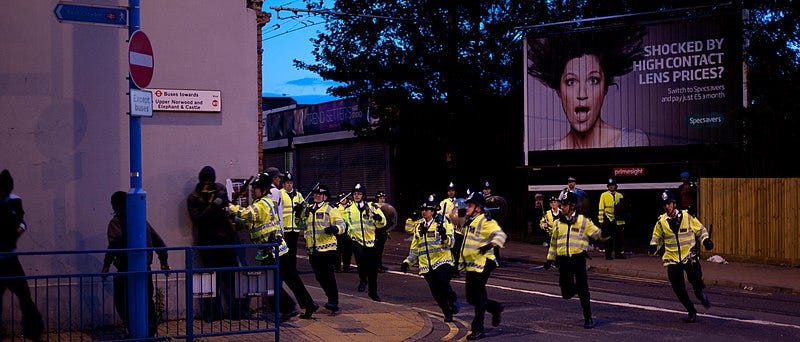
As if worries about the unleashing of disorder in London’s classrooms wasn’t enough, there was ‘lawlessness’ on the city’s once bustling for very different reasons, Oxford Street. In a more violent version of what we used to call flash mobs, bad social media was back in the headlines, with ‘dozens’ of youths heading to the capital’s premier high street without their credit cards. Home Secretary Suella Braverman let it be known that those responsible must be ‘hunted down and locked up’. On this occasion, I think most of us would agree that it was right that public disorder was met with horse-mounted, baton-wielding force.
That this event followed another in the nearby seaside town of Southend (where I used to work the rides, incidentally), gives a sense of what we could be in for across the country if we don’t get a handle on this problem too. The attempts by some to get past shop security and barriers amidst bemused tourists and shoppers, is reminiscent of the contagious rioting in London, and other English cities and towns, in 2011. And as some of us commented at the time, blaming it on poverty, adversity and a lack of youth clubs was no explanation at all. Fast forward just over a decade, and the same arguments are being made. But there are insights to be had too.
In a letter to The Telegraph, Sacha Berendji, operations director at M&S, describes how the once famed retail quarter has been reduced to ‘empty shops, littered streets and fewer visitors’. No doubt lockdown has had a big part to play in this decline, alongside the longer term trend toward online shopping. And the pending demolition of the M&S flagship store is surely uppermost in Mr Berendji’s mind too. But he’s not alone. The recent closures of other well known department stores and the rise of tacky tourist traps and dodgy sweet shops hasn’t helped either.
Hamish Mansbridge, chief executive of Heal’s, including a furniture store on nearby Tottenham Court Road, had previously told The Telegraph:
I make no bones about it, we’re seeing significantly lower footfall than we did before the pandemic, and that is a challenge. You’ve got the congestion charge, parking difficulties, tube strikes, train strikes, the cost of living crisis, and then Ulez. You name it, it’s like they’re actively trying to discourage people coming into the centre of London.
This is not merely an uncoordinated assault on the local economy and shoppers’ ‘footfall’. The de-peopling of the streets and the abandonment of retail institutions has an impact on surrounding communities, and inevitably it becomes the site of crime and disorder.
Professor Doug Stokes, author of Against Decolonisation, had this to say on Twitter:
When you destroy social norms, settled communities, and social cohesion, you are not left with a self-expressive diverse utopia but a place where might makes right, where the strong prey on the weak and raw power reins.
Watching the footage, I am struck - as I was with the Mizzy incident - at how lacking in malevolence and full of excitement those caught up in it are. Teenagers are seen running, one seemingly doing a selfie as she went, to wherever everybody else was heading.
They don’t get out much. They have no movement - apart from the confused and briefly popular Black Lives Matters mobs of pandemic-times - of which they feel a part. It reminds me of a point made by the poet Don Paterson in a fascinating exchange with younger poet Gboyega Odubanjo, in Poetry Review:
… it’s a really important dialectic; the establishment maintain the building, the young challenge its governance and force it to adapt to the changing times.
Except they don’t. The buildings have been abandoned. The establishment doesn’t stand for anything anymore. And neither do the youth assembled on Oxford Street. They are looking for something that breaks the boredom. Something exciting that is happening now. They want to experience life in the moment and to be part of something bigger than themselves, however anti-social and degraded. This isn’t to excuse their behaviour. Only to attempt a partial explanation.
I think Stokes is right to situate whatever this was - the looting seemed incidental - in this broader context of social and cultural breakdown.
As I noted in response to Stokes, and have said before on these pages:
I’ve also been struck by the sense of detachment people have from the violence going on in their communities … There’s such unwillingness to own the problem.
Is that breakdown of ‘social norms’ and unsettling of once ‘settled communities’ so thoroughgoing that we no longer identify (if you will) with any community that isn’t an extension of ourselves? Is our authority as adults really spent? I don’t think so but we can’t just look on as spectators. Scrolling through clips on social media - perhaps filmed by that girl doing a selfie - uncomprehending of those out of control youth.
Are our lives so privatised and walled off from each other that we don’t feel any obligation, whatever the resulting harm, to the people around us, or any urge to intervene in events that we think have nothing to do with us? Are those who defend the exclusion of children from the classroom standing up for the learning of the majority, or are they too neglecting their responsibility to those in the school community who struggle? Some, no doubt, will be like that young girl in Leeds, caught up in the confused enforcing of what’s left of adult authority.