

I was delighted to be invited to what turned out to be an intimate, compact yet packed gig with the lovely folk of Birmingham Salon. We were in a little room above a central Birmingham pub on a street I used to frequent as a younger man of a weekend. It is the city where I was raised and yet now barely recognise. But still it felt like home. Even after spending more than half of my adult life in London. It still has something of the buzz that I remember, even if many of my old haunts in the bulldozed Bull Ring are long gone. After some nostalgic reflections on my part, we (thankfully for those present) got going on the book.
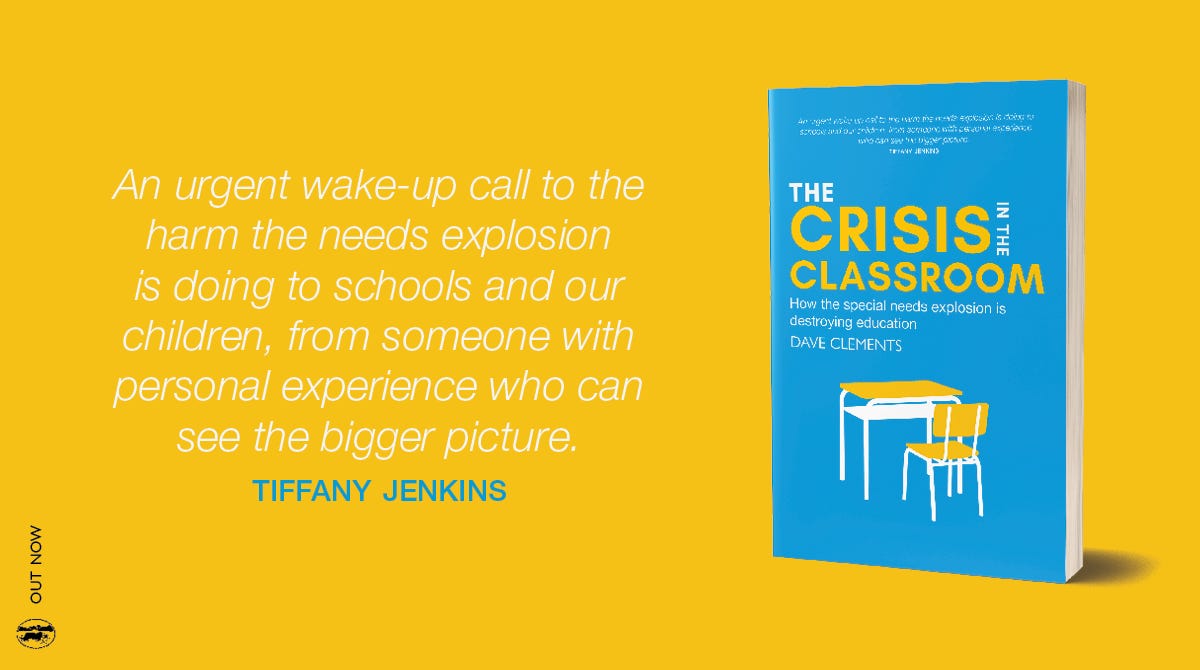
I told them a bit about why I wrote it. My son was diagnosed with Autism and ADHD in his early school years, and I latterly began trying to make sense of these increasingly talked about conditions in my Substack. Was what we were experiencing really as common as was being made out? Why the explosion in these sorts of conditions? I received a phone call out of the blue from Kevin, a teacher friend, as he was struggling too - but in the classroom with children like my son. We were coming at the issue from opposite ends. And that was how the book began - it was the product of a dialogue between a parent and a teacher. Both of us getting to grips with ‘neurodiversity’.
I broke my introduction down into three parts, starting with what I call the ‘needs explosion’, then talking about how that manifests itself in the classroom; and finally moving beyond the school gates in search of explanations for what might be going on. I talked a little about ADHD and what it is. Something I cover in the book. As I do the celebrity diagnoses that I went on to mention - Jimmy White, Sean Ryder, various reality ‘stars’ have all spoken of their relief on being diagnosed. And how everything now made sense - their snooker playing, their rock star behaviour, everything. Not that this is just a celebrity thing. Two million plus others are diagnosed with the condition in England.
I also talked a little about Autism and what it is and, this time, and again featured a few examples of cases mentioned in the book and that have emerged since. To Greg Wallace and Chris Packham, I was able to add Robbie Williams, the sadly deceased Jason Arday and the personification of evil Axel Rudakubana (who I recently discovered was also diagnosed with the condition). They all have, or had in Arday’s case, Autism. Or do they? Doubts are routinely raised. It doesn’t help that some - like Boris ‘I’m a bit spectrum-y’ Johnson - effectively make light of what can be a deeply troubling condition. There are over a million people in England diagnosed with this condition.
So that’s 3 million plus, surely closer to 4 million by now, with the two headline ‘neurodiverse’ conditions. That doubt that keeps coming up - sometimes rightly so, other times not - about the validity of some of these diagnoses points to a growing problem. The tendency to pathologise and to label people, on the one hand; and for them to eagerly ‘identify’ with it, on the other. Driven by an ‘awareness’ industry with a life of its own (particularly online) and characterised by a tension between the clinical and the cultural, as we struggle to articulate what we mean by normal these days. If we try at all.
How does all this play out in the classroom? Well, we know 1 in 5 children have a special educational need or disability (SEND), many of these with conditions like ADHD or with social, emotional or mental health (SEMH) issues. There has been a doubling in the decade since they were introduced of the once niche but now notorious EHCPs i.e. education, health and care plans. These tickets to higher-funded, legally enforceable, and more intensive support, and even to special or specialist schools, were only ever intended for kids with the most complex needs.
This has, in combination with rising demands particularly in their budgets for children and older people, threatened to bankrupt local authorities. After some heavy lobbying, they will be bailed out by central government - though we’ll still be the ones paying. In return, Councils have agreed to implement the SEND reforms, which will include placing some much needed - but highly controversial - restrictions on access to the higher end of SEND support. While I am one of small number (particularly of SEND parents) publicly supporting this move, I wonder in the book whether we need to be more radical. Do we need SEND at all?
What purpose does all this labelling serve? How is it helping the children concerned? Shouldn’t we be doing more to attend to the specific deficits or concerns that each child is facing, which can vary widely, rather than pinning a name on them and leaving them to it? Special educational needs include everything from behaviour problems to clinical needs, as well as impacting on attendance (especially since lockdown) and suspensions and exclusions - albeit affecting a wider groups of children too.
I ask whether, far from attending to children’s pre-existing needs we have created these needy classrooms ourselves? As one former head teacher told me in the book: ‘They’ve experienced life as if they can’t do it’.
What is it about our society that has made them this way? What have we done to our children to make them so apparently dysfunctional? The ideology of inclusion, beloved of the blob, is to be embedded in mainstream schools in what the government is calling ‘inclusion bases’. An education system that long ago, it seems, lost sight of what education is for; is more interested in creating inclusive utopias that - like all utopias - don’t work in practice. SEND kids cordoned off in these bases (which already exist in some schools) are not more included in school life. They are cut off from it to a greater or lesser degree. They are otherwise sort of included I suppose, in as much as they are physically present in today’s increasingly chaotic classrooms - literally the worst place for an autistic, inattentive or hyperactive child.
So, while the pulling up of the drawbridge of SEND support makes a lot of sense in my view (even if some of us may find ourselves on the wrong side of the moat); the reckless pursual of a policy that will not work but sounds nice and fluffy for the special needs kids, can only make schools worse for all of them. Indeed, we need to do more than rethink SEND (which there is much resistance to). Even shifting the focus away from engineering classrooms to returning the education system to first principles (even if it were to happen) is only ever going to be a part of the answer. The core of the problem of exploding needs lies beyond the school gates.
In the book, I spend some time on the orthodox explanations for the needs crisis. The most cited being that we’re all just more ‘aware’ of our own psychologies these days. We just know so much more about our ‘wellness’, mental health and alleged neurodiversity. And it’s all to the good! Another explanation just externalises the problem. It’s nothing to do with us, they say. Its that awful social media with it’s influencers and merchants of ‘toxic’ masculinity. They’re distracting the kids and giving them bad ideas. The tech is blamed. Ban social media for kids. Take their phones off them! They’re driving our kids crazy. I’m not convinced.
While I don’t want my kids staring at their screens all the time, and it probably isn’t doing them much good to spend quite so much time doing it - nor is it the end of the world, or the explanation for why our kids are struggling. Why not ask why our kids aren’t out in the streets playing with each other like they used to? It seems to me we terrified ourselves back in the 90s and allowed that to (mis)inform our approach to raising our kids in the new century. Our anxieties have kept them indoors ever since. Mention of which brings me to Covid, lockdown and school closures - the impact of which is yet to fully unfold, but it’s already established that children’s mental health, development and education suffered as a result.
This is quietly or at least implicitly acknowledged in official circles, but it is still somewhat taboo to come out with it and say locking ourselves, and our kids, in their homes and out of their schools was disastrous for all concerned. It is one of the taboo, yet most convincing, explanations of why children became so much more anxious, and so much less likely to attend school. But not the only one by any means. While that experience was an extreme one, it was also in a sense an extension of a wider and much earlier retreat from our communities. They fractured. We became less invested in them and less connected with each other - even though we had these new technologies on which to keep in touch.
Our ‘sense of community’ was already becoming diminished, our lives more privatised and our outlook more anxious than was ever the case before. We ended up being put on, and even putting ourselves on, the couch and creating that other crisis - of welfare dependency. This has been a growing problem, but again that experience of lockdown gave it a rocket boost (if that’s not too explosive a metaphor for the phenomena of a mass state-sponsored passivity). This is also a rather taboo topic. You’re not supposed to divide the adult population into workers vs shirkers. And to be fair, that doesn’t get it quite right anyway. The rise in benefit claims and expenditure, once associated with economic failure and the somewhat better money you get for citing your ‘bad back’ has shifted. It’s no longer a consequence of a depressed jobs market. The emergence of what we might call bad brain speaks to a depressed cultural outlook. Like the kids, the adults too are experiencing life ‘as if they can’t do it’.
So, what are we going to do? I’m tempted to say let’s return to normal. Except we can’t really do that. What was normal no longer is normal. We have to re-establish it. That means having conversations about where the boundaries should lie. About what constitutes a ‘spectrum’ of behaviours and experiences that should be considered normal - and what we should be pathologising as conditions, or labelling as needs that require support and intervention. This needs to happen from the clinic to the classroom. Adults also need to relearn what it is to be an adult - making decisions, drawing distinctions, demanding their freedom (as parents, teachers or members of the community) to be authoritative in their dealings with those lacking their maturity.
Some of the government’s reforms will help in this regard, such as its emphasis on schools rather than local authorities taking responsibility for special needs. But we can’t rely on the state getting it right. (For the most part, it isn’t.) It is up to us to change the narrative and the reality of raising these kids and their peers. It is only once we start doing this that we can begin to address the crisis in the classroom, and beyond, and repair the damage still being done by the needs explosion.
That was how I ended my introduction.
A interesting discussing followed. One of the Salon attendees suggested it was all schools’ fault. The requirement that kids sit in rows was too much for them. While I agreed children these days don’t seem to have the opportunity to run around and ‘let off steam’ as they might once have, sitting in rows is hardly a new thing! Why weren’t Victorian kids getting ADHD and creating chaos in the classroom if this notion of uniformity of schooling is so terrible? The idea that the ‘one size fits all’ approach to schooling has to change and that teachers should redesign lessons around the particular needs of a minority of pupils is absurd.
(Having said that I’m filled with admiration for teachers, like the supply teacher at the salon who talked about the ‘colours on the register’ that alerted him to the different needs of the children in the classroom.)
Another discussant pointed to processed food and other aspects of modern life, such as new media, much as did that apparently controversial Channel 4 documentary ‘The Great ADHD Myth’. I just don’t buy it. Like a lot of the orthodox takes on this subject they seem to be much more variants on existing prejudices than they are convincing explanations for the needs explosion. The food and media arguments are along the same lines as those coming from the US administration and RFK Jr. While the middle classes might no longer be vaccine sceptical on this side of the pond as some were during the MMR scandal; anti-modern arguments about supposed ‘toxins’ are pursued despite the absence of convincing evidence. The idea that our kids issues are a consequence of environmental or mental pollutants has never quite gone away.
Someone asked why we even need normal? Why can’t we just accept difference? It was an interesting challenge. First of all, counterposing normality with difference is part of the problem. We can have both. Indeed, they can and should be the same (at least up to a point). While there is growing criticism around the expansion of the Autistic spectrum and of the boundaries between ADHD and normal childhood behaviour - we should think of the everyday differences we encounter in each other as a kind of spectrum of normal human traits; and probably not as indicative of an underlying condition or disorder.
For me, the ability that most of us have to function in society without the need for ongoing or intensive support, is normal. So, while most kids can cope with and often flourish in mainstream schools - and the same may be true of SEND kids whose needs are not profound, complex or challenging; a few children will need separate, special or specialist provision. This isn’t just because, as one contributor to the discussion argued, teachers are overwhelmed and schools are under resourced (though this is undoubtedly true). Some kids are just too different to sit alongside ‘normal’ kids. They need to be taught alongside other kids like themselves in schools designed to help and support them to learn. That is real inclusion.
Being part of a community matters. Which is perhaps why, like many of us I suppose, there’s always something sad about leaving the place I was born and brought up in all those years ago. As I exited my local tube station, still thinking about the discussion, I was reminded that there is so much more to our children’s experience than what goes on in schools, or in their minds. A gang of young people forced their way through the barriers. None of us did a thing.